|
Home
| What's New?
| Get Started
| Site Map
| The Crash
| Contribute
| Resources
| Disclaimer
| Contact
|
Why the Global Economy is About to CrashAnd What You Can Do About ItSee also: What To Do About the Upcoming Economic Crash, Instant Bookshelf to Survive The Apocalypse NEW, Books About Survival in the Future Hard Times, Indicators of Overuse of the World's Natural Resources NEW, Arithmetic, Population and Energy (Video), What a Way to Go (Video), Why is Peak Oil a Problem, What the Economic Crisis Really Means - and What We Can Do About It (Video), Dystopian Fiction / Novels, Preparing for an EMP (Electromagnetic Pulse) NEW What's On This PageIntroduction The global economy (meaning modern life as we know it) is about to totally, permanently, and unrecoverably crash. I estimate that the crash will happen in the next 1-25 years. (Though potentially it could happen in the next day of trading). Even today, very few people realise just how close we really are to the end (in terms of our modern global economy and high-tech way of life)... Many people are unaware, but in the fall of 2008 [that's the spring of 2008 in the southern hemisphere], we were within a few hours of the entire banking system shutting down. Banks were on rolling notice and were within hours of being locked and electronic commerce turned off. It pains me deeply to announce that, despite the massive government rescue, yesterday’s [2008] collapse of Citigroup could ultimately lead to a shutdown of the global banking system... On October 11, 2008, a single statement hit the international wire services: "Intensifying solvency concerns about a number of the largest U.S.-based and European financial institutions have pushed the global financial system to the brink of systemic meltdown." This statement was not the random rant of a gloom-and-doomer on the fringe of society. Nor was it excerpted from a twentieth century history book about the Great Depression. It was the serious, objective assessment announced at a Washington, D.C. press conference by the Managing Director of the International Monetary Fund (IMF). I will be writing a lot more about this (and what can be done about it) on survival.org.au in the next few months, so stay tuned if this is something that you are interested in. I will probably also be updating and fine tuning this page (to make it better). Why Is The Economic Crash 100% Guaranteed to Happen?There are two reasons which combine to create the conditions that make the crash 100% inevitable.
Quick Mathematical Proof that the Economy is About to CollapseHere is a quick mathematical proof that the economy is about to collapse. If you don't like maths too much, there is a much quicker version further down this page. Or click here to skip down the page to the next section. The proof looks like a lot of writing on the page (i.e. not really that quick at all) because of the way I've written it, explaining a lot of detail. But once you read it and get it, the actual guts of it are pretty short. Exponential GrowthEconomic growth is an example of a mathematical concept known as exponential growth. Some of you may recall this from senior high-school maths. In high school it is presented as a "function" where some number is taken to the power of some other number. (This part of the page is new and I'll improve the wording and this description). Exponential growth is a name for a specific type of relationship between two quantities. In our case, one quantity is time and the other is the size of the economy. The defining feature of exponential growth is that as you add something to one quantity, the second quantity multiplies by something. For example, the term "3% annual growth" means that every time you add one year of time, the dollar value (of the thing that is growing) multiplies by 1.03. This relationship can be deceptive because you might think of "adding 3%" as if you were mathematically adding something. However this is not entirely correct. Yes, you are "adding 3%", but what is 3%? It is 3% of the thing that is growing. And the word "of" in maths means to multiply by. So really, you are adding 3% (which equals 3/100 or 0.03) multiplied by the original value of the economy, to the original value of the economy. Which is mathematically equal to multiplying the size of the economy by 1.03. Similarly, a 10% increase means to multiply by 1.1, a 50% increase means to multiply by 1.5, and so on. Any time you hear of anything being talked about as a percentage rate of growth, or growing by some percent per annum (or per any regular time period), they are talking about exponential growth. Bank interest and the return on investments are other examples. [Optional paragraph]: If you want to understand this in terms of the usual senior high-school formula for exponential growth, then read this paragraph (this paragraph is not necessary to understand the proof, so feel free to skip it if its too technical). The most common form of the formula used in school is N = N0ekt, where N is the number that is growing exponentially, N0 is its value at the beginning, e is the mathematical constant 2.71828182846, k is some constant that determines how fast it will grow, and t is time. Note that it is possible to change the "base" e to any number you like, provided that the growth rate constant k is changed appropriately. This is a result of the index laws, and is easier to see with whole numbers than it is with e, for example 100t = 102t for any value of t, but it still works for non-whole numbers. So exponential growth is just a power expression where the base is constant and the power that that base is being raised to varies with time. Consider also that raising a number to a power is just multiplying that number over and over and over. For example, 5 to the power of 3 = 5 cubed = 53 = 5^3 = 5 x 5 x 5 = 125. Five to the power of 4 = 54 = 5^4 = 5 x 5 x 5 x 5 = 625. And 55 = 5 x 5 x 5 x 5 x 5 = 3125, and 56 = 15625. You can see that with an exponential relationship, the numbers start to get big pretty fast. You can also see that it conforms to our previous definition of exponential growth: Every time you add one more to the power (in this case that's one more power of five), you are multiplying the whole result by the base (in this case by five). Note that you can add any number to the power and it still works. The base will always multiply by some other number. For example if you keep adding 2 to the powers of 5, the result will multiply by 25 each time. If you keep adding 1/2 to the power, the result will multiply by the square root of 5 each time. It is this ongoing, repeated multiplying feature of exponential growth that is responsible for the problems we are about to run into with our economy. World Economic GrowthTypical world economic growth for the last few decades has been about 3%, as you can see in the graph below.
So this 3% per year is the amount of growth, roughly, that is required to keep the economy as we know it running. It may be possible that the economy could run long-term on a slightly lower rate of growth. However one you get much lower than that, the economy becomes unstable and if a healthy rate of growth is not eventually restored, economic collapse is guaranteed to follow. This is why you hear people talking about economic growth all the time on the news, almost as if their life depended on it. Their life (and your life, until you are able to survive without reaping any of the fruits of the modern economy) does depend on it. The graph below shows Australia's economic growth, which is quite similar to that of the world overall. Draw your finger along the average (middle) of the peaks and valleys, starting from the right hand side, and you can see what percentage rate of growth is typical for the economy.
The next graph (below) is especially interesting since it shows the growth in USA energy consumption all the way back to the year 1650. Note that the vertical scale of this graph (i.e. the units down the left hand side) is logarithmic. If you are not a scientist you might not be used to reading log graphs, however they are not that hard to read. All you really need to know is that as you go up the scale in steps, the number that is being graphed multiplies rather than adds. That is, instead of "linear" units like 10, 20, 30, 40, 50, 60, etc., we have "log" units like 10, 100, 1000, 10000, 100000, 1000000, etc. On the graph below, the horizontal scale is "linear" (i.e. like an ordinary non-log graph), and the vertical scale is logarithmic. In other words, time (across the bottom) increases by adding years for every step across the page, and the energy consumption (up the left side) increases by multiplying energy use for every step up the page. If you've been reading from the start of this proof, you might recall that type of relationship (with one quantity being multipled when another is added) is exactly what we defined exponential growth to be. For this reason, exponential growth on this log-linear graph appears as a straight line. (This is the whole point of why the graph was drawn like this, with the log scale on the left). The blue dots on the graph below represent the historical data. The red line represents a growth rate of 2.9% per annum. I found this graph and information after I has already written this proof as based on a historical growth rate of about 3% so it was interesting to see this confirmed (at least for the USA) all the way back to the year 1650. On the same website there is also this article about exponential economic growth and why it cannot last much longer. The numbers on the left of the graph refer to "powers of ten" which are 107 = 10000000, 108 = 100000000, 109 = 1000000000, 1010 = 10000000000, 1011 = 100000000000, 1012 = 1000000000000, and 1013 = 1000000000000. Each time the "power" (the small number written above) increases by one, the total number multiplies by 10. Plotting data from the Energy Information Agency on U.S. energy use since 1650 (1635-1945, 1949-2009, including wood, biomass, fossil fuels, hydro, nuclear, etc.) shows a remarkably steady growth trajectory, characterized by an annual growth rate of 2.9% (see figure).
Searching the internet to find what economists regard as a healthy rate of economic growth brings up similar values. A couple of examples are here (2.5% to 3%) and here (2% to 4%). The Doubling PeriodRecall (from above on this page) that when we say "growing by 3%", or "adding 3%", what we really mean is multiplying by 1.03. And that a healthy overall rate of growth for the global economy is 3% per annum, i.e. multiplying the size of the entire global economy by 1.03 times each year. If you wish, try this as an exercise. Get a calculator (any will do). Start with the number 1, and multiply it by 1.03. Then multiply your answer by 1.03. Then multiply that answer by 1.03. If you think of the original "1" as being the size of the economy, you can see how it is growing each year. Keep multiplying by 1.03 and count how many "years" it takes for the number to reach 2. I just did this and it took 24 "years" to get to 2.033 which was the first number bigger than 2. Each multiplication by 1.03 represents the growth of the economy for one year. So, in real life, the 24 steps of multiplying represents how long it takes for the economy to double in size: about 24 years. If you keep on growing your virtual economy in your calculator (i.e. keep multiplying by 1.03), you will find that it will take another 24 years to double again to 4 (actually it would be 2.033 squared, but this is close enough to 4 for us). Another 24 years of growth will double it again, to 8, and after another 24 years again it will be 16. If you have lost count that is 96 years (close enough to a century), in which time the economy must grow to 16 times its current size. Which implies 16 times as much of everything that we consume overall will be required to power the economy. Considering that we have already used more than half of many of the natural resources critical to the functioning of the modern economy, I think it is a pretty safe bet that the economy as we know it is not going to last for another century (or even close, as we will examine on the rest of this page). Note that you could start with any number at all (other than zero), and keep repeatedly multiplying it by 1.03, and it will still take the same magic number of 24 steps of multiplications to get to double its original size. This number of 24 years we have been using is known as the "doubling period". If you have been following this page up to here, the reason why its called the doubling period is pretty obvious. It's how long it takes the size of the economy (or the size of whatever is being talked about that's growing exponentially) to double. All examples of exponential growth have a doubling period, and its value is entirely dependent on the rate of growth. As we discovered by using the calculator, for 3% growth the doubling period is 24 years. (Actually it's slightly less than 24 years, since 24 years is a growth of 2.033). Going back to our original definition of exponential growth, we can also write this definition in terms of the doubling period. Every time we add one doubling period of time (e.g. in years), the thing that is growing exponentially (e.g. the size of the economy) multiplies by 2 (i.e. it doubles). You can calculate the doubling period for the economy (or any financial index, or investment) approximately by the "rule of 72". You just divide 72 by the percentage rate. So in our example, that would be 72 / 3 = 24. Sometimes other numbers are used, mainly 69 or 70, in which case it's called the rule of 69 or the rule of 70. It's only an approximate rule so near enough is good enough. 72 is popular because you can divide it by many different small numbers and still get a whole number. For example, using the rule of 72, for 2% growth the doubling period would be 72 / 2 = 36 years, This is exactly the same as saying that if you had some money in the bank at 9% interest, then approximately every 8 years it will double. [Optional paragraph]: If you want to calculate the doubling period exactly, it's log 2 / log (1 + R/100), where R is the rate of growth in percent. You can use any type of logarithm, e.g. base 10, or base e (i.e. the natural log which is often written as "ln"), as long as you use the same one for both of the logs in the formula. In other words you can use either the "log" button or the "ln" button on the calculator as long as you use the same button both times. If the exact formula looks confusing, you don't need to understand it (or use it at all) to follow this proof. And the 1 + R/100 part is just the conversion of 3% to 1.03, so in our example of 3% growth, the formula for the exact doubling period is just log 2 / log 1.03 = 23.45 years. If your calculator doesn't do logs, or if this is too hard, just use the rule of 72 (which is just 72 / R, where R is the rate of growth in percent). Using an approximate formula is not a big deal since the 3% growth is only an approximate number anyway. If we wanted to make the doubling period exactly 25 years so we could use a nice round number for this proof, that would mean an annual growth rate of 2.811%, which is still a very realistic figure for the global economy. Using the exact forumla, for 2% growth the doubling period would be 35.00 years, for 3% it would be 23.45 years, and for 4% growth it would be 17.67 years. 2.9% growth (like in the graph above showing USA energy use from the year 1650) is a doubling period of 24.24 years. What the Economic Doubling Period Really MeansThe doubling period is exactly what is says, how long it takes something to double. However (also kind of obviously) we are talking about something that is growing. And now, we are also talking about it doubling. And this is where it starts to get freaky. If something is doubled, then, obviously, the second (doubled) half of that thing is the same value as the first (original) half. That is, if you double the number 30 then you get 60, i.e. 30 more than you had before. And each of the two 30s, the 30 that you started with and the new 30, are both the same as each other. In regards to exponential growth, however, what is important to realise is that if you double 30 to get 60, the second "30" represents just that one new doubling period. And the first "30" represents everything else that has ever happened before it. Another way to say this is that in any one doubling period, the amount that the resource consumption grows by is equal to all the amounts that it has ever grown by before, combined. In a sense this is completely obvious, since that's what doubling is. However in another sense, it's not something that we usually think about, and it has truly freaky implications for the global economy. The economy uses up resources in proportion to its size — since that's what the "size of the economy" is — it's the level of real (i.e. inflation adjusted) economic activity, i.e. all the stuff we mine and build and farm and eat and buy and sell and everything we do that has a monetary value on it. More technically, it is the value of real Gross Domestic Product (GDP), which is the value of all officially recognised final goods and services produced within a country in a given period of time. In other words, the inflation-adjusted (i.e. real) value of GDP is used to calculate economic growth. Clearly if you need to double the number of real goods and real services provided, the number of raw inputs that goes into making them is also required to (approximately) double. So every time the economy doubles it needs double the number of resources. And the (doubled) number of resources needed for just that one doubling period is equal to the total amount of resources used in all of history up until then. In this mathematical example it is exactly equal, and in real life it is approximately equal. The approximation being made here does not detract from the certainty of the proof. As you are about to discover, the repeated multiplying effect of exponential growth is so intense that you can be out by quite a big margin here and still have a ridiculously large gap between what the economy needs to keep going and what is possible. Another way to illustrate it is like this: We pick a number to start with — which represents the size of our economy at the start of calculations. This demonstration will work for any number at all (except zero), so we might as well start with 1. (As an exercise, you may wish to repeat the following process using a different starting number, and verify that it does still work). Now keep on doubling that number. If you keep doubling 1 you get 1, 2, 4, 8, 16, 32, 64, 128, 256, 512, 1024, 2048, 4096, and so on... In exponential growth, the amount of time taken to get from each of these numbers to the next number is exactly the same, one doubling period. Notice that 1 + 1 = 2. The first 1 represents everything we have used before the current doubling period, and the second 1 represents everything we have used in that doubling period. If you want to be really deep here, the first 1, which represents all of previous history before we started our calculations at a size of 1 for the economy, is made up of 1/2 + 1/4 + 1/8 + 1/16 + 1/32 + 1/64 + 1/128 + ... and on and on, going backwards into the past (since for every doubling period we go backwards in time, the economy halves). If you add up this series all the way back to infinity, you get exactly 1 — which is the first 1 in the above equation of 1 + 1 = 2. Now let's keep on adding more doubling periods..... Adding on the next doubling period of 2 gives 1 + 1 + 2 = 4 The next doubling period is 4 so we have 1 + 1 + 2 + 4 = 8 and 1 + 1 + 2 + 4 + 8 = 16 and 1 + 1 + 2 + 4 + 8 + 16 = 32 and 1 + 1 + 2 + 4 + 8 + 16 + 32 = 64 and 1 + 1 + 2 + 4 + 8 + 16 + 32 + 64 + 128 = 256 and 1 + 1 + 2 + 4 + 8 + 16 + 32 + 64 + 128 + 256 = 512 and 1 + 1 + 2 + 4 + 8 + 16 + 32 + 64 + 128 + 256 + 512 = 1024 In the next doubling period, the economy will grow from 1024 to 2048, and it will consume the same amount of resources in just that one period as it has needed for all of its previous history where it has used up resource amounts of 1 + 1 + 2 + 4 + 8 + 16 + 32 + 64 + 128 + 256 + 512 = 1024. Now the economy has grown to size 2048. Up till now, including the latest 2048-level doubling period (which is the 11th doubling period if you count the number of periods), this economy has used 2048 times its initial (starting) level of resources in total (i.e. ever). Which is made up of 1024 lots of resources for the previous period plus 1024 for all the periods before that combined. 1024 + 1024 = 2048. And for the next doubling period after that, it will use up that same 2048 times the intial resources in just that next single doubling period. And you can see that this is true of any doubling period. Every time the economy doubles, the (doubled) amount of physical resources required to power it during just that one next doubling period will be the same as the amount used in all previous doubling periods combined — that is, in all of history before it. The punch line: And as we have seen, for the global economy, this doubling period is approximately 25 years. Once you start to get your head around how exponential growth works, the implications are pretty staggering. And since they are based on nothing but pure maths, there is no possible way to argue against them or disagree with their reality (unless you also disagree that 1 + 1 + 2 + 4 + 8 equals 16). If we take a round figure of 25 years for the doubling period of our global economy, then in the next 25 years we will need to find (from somewhere on the planet) new supplies of critical natural resources such as minerals, farmland, forests, topsoil, fresh water, etc., equal to the total amount we have already used in all of previous human history. For the next 25 years after that, which is another doubling period, we would need twice that much on top of that just for that extra 25 years alone. That is, to go for another two doubling periods (which is 50 years at 3% growth), we will need three times as many natural resources as the total amount that we have ever used in all of history up till now. This just keeps going. To run the economy from now till the next 25 years after that (i.e. another doubling) we will need four times what we have already used up till now, plus the one more for the next 25 years and two times more for the 25 after that — that is, 1 + 2 + 4 equals seven times the total of what we have ever consumed. To last (with no economic collapse) for another 25 years longer than that (which takes us up to 100 years from now in case you have lost count), we'll need to find another 8 + 4 + 2 + 1 = 15 times more resources than the total we have so far used in all of history. (If you want to match these numbers up with the table a few paragraphs above, add on the extra one more for the resouces we have already used before now, and this brings the total up to 16 for the total amount that would be used up by 100 years from now — including the 1 for all of previous history plus the 15 times more for the next 100 years from now.) Even though I'm quite mathematical — and I've known about these numbers and what they imply for years now — it still seems insane. To go for 125 more years we will need 31 times more resources than we have ever used. Another 150 years of business as usual would need 63 times more, 175 years would need 127 times more, and for another 200 years of our economy we would need 255 times more natural resources than the total amount we have ever used in all of human history.. Considering that in 1986 it was estimated that the human species was using 40% of the Earth's primary productivity (Vitousek et al., 1986), a measure of the total amount of natural resources available to all species on the planet, and we have grown since 1986, then it is completely impossible for us to multiply our consumption by a factor of several times (let alone 255 times). We have already used about half of the available oil, over 75% of the topsoil that existed in the 1500s is now gone, and the human race currently consumes about 1/3 of the entire biological production of the oceans, and uses about half of the world's available fresh water. So it's going to be pretty difficult for us to be able to double our consumption much more than one more time, and quite possibly not even one more. Since one doubling period is about 25 years, this puts an upper limit on the time remaining for modern industrial civilisation as we know it of about one human generation. It might, of course, be less than that. Since it is common for the rates of resource extraction to start slowing down once you have used over half of the available qualtity of the resource (peak oil is an example of this), and the growth requirement of the economy needs the rates of extraction to keep increasing, this means the economic collapse is likely to happen before everything is completely used up (which is a good thing really, if you think about it). Because of the business ownership and sponsorship behind our mainstream media — which are run in order to generate a profit for business — the "anti-growth" message of this web page is not widely publicised, and most people are unaware that the majority of the world's Nobel Prize winners are in full agreement with this view. Arithmetic, Population and EnergyFor another explanation of exponential growth (and some of the issues that come out of our need for it), I highly recommend that you watch this excellent online video by Professor Emeritus Al Bartlett. I've found that this video, more than anything else that I've seen, is able to convince the most logically minded people that the economic collapse is approaching. You simply can't argue with pure maths. (Unless you also want to argue that 1 + 1 + 2 + 4 + 8 does not equal 16). Completely and Utterly ImpossibleThe same page where I got the graph going back to 1650 also has an interesting calculation: Imagine we could keep going ahead into the future, based on an annual growth of 2.3% — which is less than what we are used to, but perhaps still possible long-term, without the economy crashing, if we could find the resources from somewhere. 2.3% growth is a doubling period of 30 years, and a time to multiply by 10 of 100 years (a nice round figure, which is why they chose to use it for this example). In other words, at 2.3% growth, every 100 years the economy will get 10 times bigger, and consume 10 times as many resources (including energy resources). Many years ago, when I was considering what career choices would most help the human race overall, I thought about doing research into developing fusion power as a possible choice. The way I saw it back then, energy shortage was going to be a critical issue for the human race, and if fusion power could be developed this would provide vast amounts of energy that our growing economy would need. Since then I've come to realise that even if fusion power could be developed (which is unlikely anyway), although it could keep the economy running a bit longer before "the crash", it would only make things worse in the long-term. The Earth's surface temperature is a balance between heat received from the Sun and heat lost into space. Apart from nuclear power, all the energy we use comes from the Sun, or once came from the Sun (as in fossil fuels). The graph below shows a calculation of the Earth's surface temperature in the future, assuming we multiply our current energy use by 10 every hundred years. Which is a growth of 2.3% per year. For the next couple of centuries we may be okay, and the temperature does not go up much, since the Earth is capable of radiating most of that heat back into space. However, as each century passes and we have to use 10 times as much energy as the century before, eventually the amount of energy our "healthy" economy needs becomes too large for the Earth to radiate away, and the temperature really starts to rise.
It's a pretty safe bet that our global economy isn't going to be able to maintain a "healthy" rate of growth for much longer, no matter how many new sources of energy we discover. Quick Proof that Really is QuickThis is a much shorter version of what's above, i.e. a mathematical proof that the global economy is going to crash within about one human generation (or less).
QED. (End of quick proof.) People DoublingThe world's population is now 7.1 billion in 2013. It was half that (3.5 billion) 45 years ago in 1968, and half that again (1.7 billion) 100 years ago in 1913. Which is a doubling period for population of about 45-50 years. Of course the material standard of living and energy and resource consumption per person for most of these people has also increased dramatically. It's sometimes easy to forget that there were only half as many people alive in 1968. To a lot of us, 1968 doesn't seem like that long ago. Those people used much less resources per head of population than people do now. If you've read the explanations above, going back to the 1960s is about two economic doubling periods backwards. And if you double "backwards" that makes them halving periods. So in the 1960s the world's population was half and the level of world economic activity (and resource consumption) was about 1/4 of what it is now. Sometimes economists talk about how in developed countries (usually this means first-world) countries, population growth slows and even stops once a certain level of material progress is reached. And this is used as an argument for how the rest of the world can follow our shining example (of slowing population growth) once they make enough stuff for us, and by doing so increase their own standard of living. The thing that is never mentioned, though, is where are all the people going to be who are making all their stuff for them?, once their standard of living has grown to equal ours in the rich West. In case you think that maybe they can make their own stuff, and still have our first-world standard of living, as a practical exercise, try buying nothing from China or any developing country, and setting up local enterprises to make (not just assemble from imported parts) things like TV sets, clothes, computers, smartphones, etc......... Or even food. To do the exercise properly, you also can't use or spend any money that was earned in any way as a product of the economic activity of a developing country (e.g from the exports of goods, or from a business that uses third world labour, or from an investment portfolio that includes businesses that export goods or use third world labour etc.). If you think about this, its completely impossible to have anything like the material standard of living that we (in the West) are used to without relying on others much worse off than us to provide things for us. Slavery is the first step towards civilization. In order to develop it is necessary that things should be much better for some and much worse for others, then those who are better off can develop at the expense of others. Most people don't like to think about this any more than they like to think about the coming economic crash. Although this can be depressing, it can also be seen as a really good kick in the butt to get us motivated to do something for ourselves, without using so many resources and man-hours from other parts of the world. Ongoing Economic GrowthI've already written a lot on another page about why we need ongoing economic growth in order for our modern way of life (and economy) to exist. And how not having enough growth for a long enough period results in guaranteed economic collapse. I think that probably, for most economists, to say "There can be no more long term growth. Ever.", would be too ridiculous an idea to even consider. We have to have an economy, so we have to have growth..... So there can be no other possibility..... I think that to say to an economist that we can have no more growth would be like telling "Goldmember" (from the Austin Powers movie) that he could have no more gold. Or like saying to a Christian that Jesus wasn't resurrected, or to a Buddhist that there is no such thing as Nirvana, or... (you get the idea). What I mean is, it's a pretty big deal, and its conflicting with something that they have taken on as a statement of faith. These problems [of resource depletion, continued population growth, declining per-capita food production, global climate change and other signs of environmental degradation, unsustainable levels of US debt and a potential dollar collapse, and international political instability] are related to each other in complex, often mutually reinforcing ways. Taken together, they constitute the most severe challenge our species has ever faced. They represent not merely a likely culmination of human history; in their ongoing and potential environmental impacts, they also may collectively signal one of the most momentous events in all of geological time.
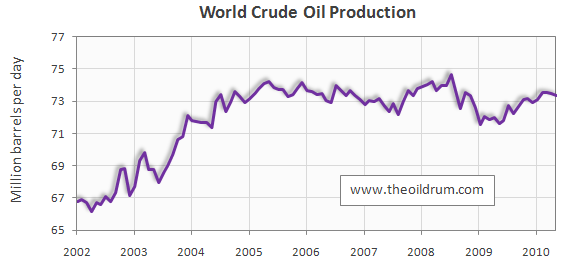
Resource Availability ConstraintsThe first of the resource availability constraints that I'm talking about is what people call peak oil. Peak oil is just one of the many problems that are converging upon the human race within the next generation. If you want to see an overview of these problems, click here to skip to the summary section of this page. There is a lot written about peak oil already on the internet, including on this site. To summarise what peak oil is in one paragraph, peak oil is the point in time at which the rate of extraction of crude oil reaches its all-time high. After the peak is passed, forever after (and this means forever) there will always be less and less oil available to the market. There are still people in the media who refer to peak oil as a theory. The word "theory" here is used to imply something that has been suggested, but not proved for certain. Peak oil was a theory in 1956 when M. King Hubbert predicted that the United States domestic oil production would peak in about 1970, and then forever after go into decline. Peak oil stopped being a theory in 1970 when this came true just as he had predicted. Since then, country after country has already peaked and gone into terminal decline. Australia peaked in 2000 and has been in decline ever since (and will be forever after). There is no-one disputing the historical statistics for the amounts of oil extraction, so it is quite easy to look back at the numbers and see that peak oil (for individual countries) is completely, 100% real and verifiable. Global peak oil is where peak oil happens for the Earth as a whole. Since there is not an infinite number of countries in the world, and there is no single country with an infinite amount of oil, it follows logically that as one country after another peaks and goes into decline, at some point the whole world will peak, and then go into decline. There is absolutely no doubt whatsoever that peak oil (in the global sense) is real. Finally, even if there was an infinite amount of oil, there are a great many other critical resources that are also peaking at around this time, and about to go into decline. The Economic Crash — It's Not About MoneyEconomists (and the regular mass media news broadcasts) like to talk a lot about money, markets, and economics. In the end, it will appear to many to be those things that "cause" the crash. However money is just bits of paper and numbers in computers. It makes a lot of difference to individuals' lives — but on the global scale, it matters relatively little how much money there is, or even who has it, in terms of real things that are available. Things such as food, water, housing might be brought to you personally by people who are motivated by the flow of money, and in this sense it does obviously affect you. However the total amount of real, physical resources available in the world is unaffected by money or by markets. It could be said that individual people are (in a sense) made rich or poor by the flow of money. However, no matter how you redistribute money, the entire Earth as a whole will still be exactly the same in terms of the total amount of physical resources that exist. Since the problem we are now facing is about the total amount of physical resources that exist, no amount of manipulation of monetary systems will have any permanent effect on the problem. I'll repeat this point, since there will be a lot of people who don't get this, both now and for many years after the real crisis gets underway. Once enough of the Earth's physical natural resources are used up, no amount of changes to the monetary system (or any other economic changes) will make any difference to the resource shortage in the long term and in the big picture. The reason that some people have trouble understanding this point is because they are used to thinking of so much of their everyday lives in terms of the flow of money. People's life experience tells them that money can buy almost anything. Perhaps apart from invisible and intangible things like "love", money can pretty well buy anything. (With all due respect to Sir Paul McCartney, in many people's life experience, a lot of the time money can even buy intangibles, including love). When people watch the mainstream media, it seems like almost all of the big issues in the world are one way or another about money, trade, commerce, or politics. The actual, physical, amounts of resources that are needed, and the amounts that are remaining, are almost never mentioned. For example, the price of oil is stated in nearly every news broadcast, but the amounts of oil that are used each day, and remaining, are almost never mentioned. Occasionally new discoveries of resources are mentioned, but this is usually because the discovery makes some companies' share price go up, and is being mentioned mainly (or entirely) because of its effect on the flow of money. Because of this bias of exposure in the media, people are not used to thinking of real actual physical natural resources as important (or even thinking of them at all). When in fact they are the underlying basis for all trade, commerce, and politics. Another effect of this fact is that the upcoming crash is not the banks fault, or the government's fault. It's nobody's fault and everybody's fault. Oil is Peaking About Right NowThe balance of available evidence is that oil is peaking right now. That is, give or take a few years, we are basically at the all time high in terms of rate of oil extraction. The fact that we are at (approximately) the highest point so far in history is obvious from the statistics. The graph indicates that the global output of oil has been approximately constant since 2005. Note also that the scale on the left hand side of the graph does not start from zero at the bottom of the graph. This has the effect of exaggerating the ups and downs in the graph. If it were drawn to scale, it would look a lot flatter than it does below. Whether or not this means that we are at the all-time high of oil extraction (or, conversely, whether this graph can still go up a lot in the future, as is required for the global economy to continue to exist for any length of time), is something that you can read about elsewhere (it takes more than a paragraph to explain). For here I will just say that I have been following this issue on and off since 1979, and in detailed research since about 2001, and I am convinced that it is unlikely there can be no more short-term significant increases in oil production, and almost completely impossible that there will be long term ones. I have more of an explanation of this here. We are now in the period in history that is referred to as the "petroleum plateau", the flat-ish spot at the top of the all-time oil extraction curve. The flat spot could potentially continue for a while longer (I would estimate perhaps another decade, maximum, and probably less than that), or it could end this week. This flat spot is characterised by a period in which global economic growth is at first slowed, then capped to a standstill (approximately zero growth). The initial effects of this in global (and domestic) financial markets are quite apparent from watching regular news broadcasts. What it important to realise is that even if oil production (i.e. extraction) could continue forever at this current "petroleum plateau" rate (which it can't), that would still not be enough to stop the global economy from completely crashing. The amount of oil that we use globally needs to grow, and keep growing (in the long term scale, not just for a year or two), in order for our modern economies to continue to exist.
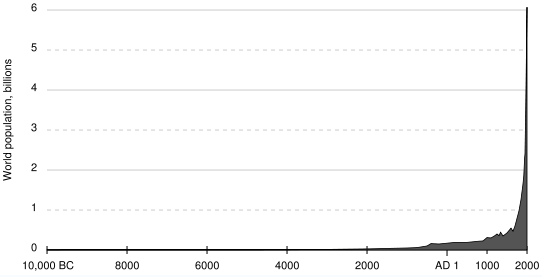
If you want to see future versions of this graph, Google "oil drum oilwatch monthly" (without the quotes) and click on the most recent month that comes up. Then scroll down to the graphs for World Crude Oil Production and World Liquid Fuels Production. According to The Oil Drum, 'As everyone knows, there is never a post on The Oil Drum that the entire staff agrees on. Nonetheless, Tony bases his findings on solid research, and a staff survey shows that most agree with a 2008 peak. A post discussing whether an alternate scenario with a second later peak might be feasible is planned for later. World oil production peaked in 2008 at 81.73 million barrels/day (mbd) shown in the chart below. This oil definition includes crude oil, lease condensate, oil sands and natural gas plant liquids. If natural gas plant liquids are excluded, then the production peak remains in 2008 but at 73.79 mbd. However, if oil sands are also excluded then crude oil and lease condensate production peaked in 2005 at 72.75 mbd.' According to Wikipedia, 'Worldwide oil production, including oil from oil sands, reached an all-time high of 73,720,000 barrels per day (11,721,000 m3/d) in 2005. By 2009, production had declined to 72,260,000 barrels per day (11,488,000 m3/d). In Feb 2010 the US military's Joint Forces Command issued the Joint Operating Environment 2010 warning US military commands "By 2012, surplus oil production capacity could entirely disappear, and as early as 2015, the shortfall in output could reach nearly 10 million barrels per day."' The Real, Underlying Problem — It's Not Just Oil That's Running OutIt's not only oil that is peaking at around this time in history. Have a look at the graph of world population below:
Considering the graph above, notice that the shaded area under the graph gives an approximate idea of the amount of resources that will be consumed by those people. Consider also that modern people use far more resources per person than people did in the old days. (For example, the average person in the USA has 70 times the ecological footprint of the average person in Bangladesh). Therefore, the closer you get to the right of the graph, the more resources are needed per person. Which means the extreme increase in population on the right of the graph is even more extreme in terms of resources. What this means is that in order for business as usual to continue for just another generation (say 30-40 years), the amount of resources the world will need for just those next few decades is roughly equal to (or greater than) the total amount of resources that have ever been consumed, ever, in the history of the human race. If this seems hard to believe, the online video by Al Bartlett explains quite well how, in a situation of exponential growth, the area under the graph for just one doubling period exactly equals the area under the entire rest of the graph. This is why it seems like "everything" is running out now, or about to run out. Because it is. When you consider also that we have already used more than half of the available oil, over 75% of the topsoil that existed in the 1500s is now gone, the human race now consumes about 1/3 of the entire biological production of the oceans, and over 40% of the total resources available to all species on the planet, and our global economy must continue to grow in order for it to continue to exist, it is clear that we are about to run into some big changes. In the 24 hours since this time yesterday, over 200,000 acres of rainforest have been destroyed in our world. Fully 13 million tons of toxic chemicals have been released into our environment. Over 45,000 people have died of starvation, 38,000 of them children. And more than 130 plant or animal species have been driven to extinction by the actions of humans. (The last time there was such a rapid loss of species was when the dinosaurs vanished.) And all this just since yesterday.
I just did an internet search for how many people die of starvation a day to check the above figure (which seemed so high). Most of the quotes range from about 15,000 to 40,000 a day, with some lower than that and some as high as 60,000. Apart from the expected problems of counting something like that precisely, there is also the issue of what is considered to be dying of starvation. The bigger death rate numbers include deaths from illness resulting from malnutrition (from lack of food) in the count, so these people have not strictly died from starvation in the sense of having no food, but the lack of food is what caused the illness that caused them to die. Still, it seems hard to get my head around it. While most of us in the rich west still find the idea of economic collapse hard to imagine, for some parts of the world it is already here, and it is their daily reality, now. If you have some motivation to learn what can be done to lessen the impact of the coming economic crisis — while we still have access to all of the benefits of the modern economy — and while we can predict many of the kinds of things to expect — this represents an absolutely massive advantage. NEW PAGE: Indicators of Overuse of the World's Natural Resources. Economic Collapse: What To Do About ItThe sooner you start on this, the better (for you and, to some extent, for everyone else). If you find that you can't deal with it (at first), whatever that means for you, you are going to be much better off going through this phase of reality sinking in before the economy crashes and before things start to really change. While we still have all the conveniences and benefits of modern life and of our availability of technology, information, tools, social stability, and so on. It's not something that is outright impossible to deal with, since people have been living in ways other than our current modern high-tech lifestyle for the whole of human history up till very recent times. See here for more: What To Do About the Upcoming Economic Crash SummaryThe practical outcome of this is that the modern way of life we have all become accustomed to is about to change on a major scale. This website (along with many others on the internet) is an attempt to help people to come to terms with these changes, and to take appropriate action in response. See alsoWhat To Do About the Upcoming Economic Crash above add adding already amount amounts annual approximately base before case collapse completely consumption continue country crash current does double doubling earth economic economy effect energy entire equal everything exactly exist exponential extraction food future global graph growing growth half healthy high history however human including keep level life log longer mathematical means modern money multiplies multiply multiplying natural next note numbers oil once ongoing original page peak people period periods physical population possible power previous production proof quick rate real represents resource resources run scale second source start takes term terms times total value video whole why world year years Content is copyright © Survival.org.au 2005-2026 All Rights Reserved. Terms of Use. Definitely read the disclaimer before trying anything from this website, especially including the practices and skills. This website uses affiliate links – this doesn't cost you any more, but I get a commission on purchases made through the website. As an Amazon Associate I earn similarly from qualifying purchases. |
 |


 NOTE: If you want the ultra-quick version, read only the parts in bold font.