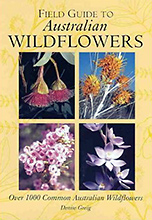
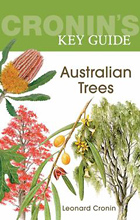
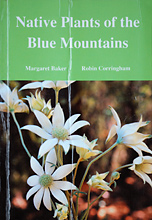
Australian Field Guides and Nature Books
See Also: Survival Books, My Top Two Survival Books, Survival DVDs, Permaculture, Self Sufficiency And Sustainable Living Books, Dystopian Fiction / Novels, and Books About Near-Death Experiences.
NOTE: This page is in the process (as of mid-2024) of being migrated from survival.ark.au/books.php to ark.au/nature-books.html. It will be further updated soon...
This page contains (mostly) specifically Australian books. The non-Australian books that are displayed are also relevant to Australia. The other pages listed above have books that are relevant to any country.
This page suggests some books to get if you are interested in learning more about the kinds of things you see on Ark.au. It mainly contains nature guides and other related books. I will be adding more other pages that describe other kinds of books.
In many bookshops (especially online ones) you are presented with hundreds of books and not much idea which one(s) to get. So here I have described the books that I myself have used to learn from, and that are the most popular and the most recommended. (Since I have spent a ridiculous amount of time over the last several years looking into what books are available).
NEW: Note from 30 June 2020 — I've gone over most of the links and fixed them and/or or labelled the out of stock items, though there are probably still a few more to do...
Note from February 2017 — Most of the books from The Nile on this page, which were listed a few years ago, seem to be unavailable now. Occasionally these books become available again so I've left the links working, but marked them e.g. as "May be unavailable". I'll try to find other sources for these that work and add new books soon.
Currently I'm getting commissions from the books listed from The Nile,   Fishpond, Amazon.com, Amazon.com.au, and Amazon.co.uk. They range from about 3 to 6% of the item price and it helps to justify the time spent on this website. If I consider an item to be important, but can't find it from a seller with an affiliate program, I usually still list it although I don't get any financial benefit. Fishpond, Amazon.com, Amazon.com.au, and Amazon.co.uk. They range from about 3 to 6% of the item price and it helps to justify the time spent on this website. If I consider an item to be important, but can't find it from a seller with an affiliate program, I usually still list it although I don't get any financial benefit.
I'll also be adding more nature and survival books.
Amazon is often (though not always) relatively expensive for Australian sourced books purchased from within Australia, presumably because they have to be shipped overseas (to Amazon) and then back again. Amazon used to list their "new and used" products not sold by Amazon showing clearly whether the dealer offers international shipping. Unfortunately this does not seem to be the case anymore, though on their website there are these instructions to search for items that can be shipped internationally.
Unfortunately a few of the greatest books are out of print. To find out of print books try Amazon.com,
or www.biblioz.com.
Categories Found On This Australian Nature Books Page
Wilderness Survival and Wilderness Living
Bush Tucker
Medicinal Plants
Aboriginal Studies
Poisonous Plants and Animals
Plants
Fungi
Mammals
Birds
Reptiles and Amphibians
Fishes
Invertebrates
Wilderness Survival and Wilderness Living
See here for more Wilderness Living books (from all countries, the books on this page are the Australian ones only).
|
 NEW: The Bushman's Handbook, by H. A. Lindsay. This is a really good re-published vintage book about surviving and living in the Australian bush. Vintage books are often better than modern ones, because more people knew and lived these skills back then.
Here's what the Literary Editor of Adelaide's Advertiser newspaper had to say about "The Bushman's Handbook" in late 1948: "If an ordinary city dweller were to be dumped down in the arid central regions of Australia it is fairly certain that if the season was cold he would perhaps survive a few days, but it's also certain that in the heat of summer he would be dead within 48 hours. But the aborigine would be quite at home in such circumstances, which would not be dire straits to him at all. He would know how to find water where apparently none existed, and would unearth sufficient food to enable him to travel safely to better country. The author of "The Bushman's Handbook", who is an expert bushman and descendant of bushmen, and who instructed thousands of Australian and American troops in bushcraft during WWII, here tells exactly how to survive in inhospitable terrain. As to your thirst, he describes how moisture may be obtained from the stems of plants and the limbs of trees - and he shows by illustrations just how the parched outback traveler should proceed. Food can be obtained from all sorts of unlikely sources - for instance, the bilious-looking but tasty and nutritious "witjuti" grubs can be gouged out from the bark of trees. For larger foods the reader is carefully instructed how to make simple but effective snares - to the undoing of rabbits, hares, squirrels and similar game. If you are near streams or pools you have no need to hunger if you follow the Author's instructions and diagrams which will enable you to catch the various kinds of fish without rod, reel or hook. There are also interesting and instructive talks about fire lighting (without matches); the art of camping out; direction finding if you happen to be lost; or how to cord and thatch a shelter for yourself; and on the various special plants and roots which it is safe to eat if driven to extremities. Lastly, the Author gives valuable advice on how to maintain health in the bush, and stresses the value of bushcraft, and the hardiness and self-reliance which it brings, in both peace and war. In all, an admirable and comprehensive bushman's text-book."
Four of the 18 chapters (43 out of 176 pages) are entirely dedicated to finding water in the bush.
Click here to purchase from Amazon Australia
Click here to purchase from Australia (Fishpond) (Probably Unavailable)
Click here to purchase from Amazon |
|
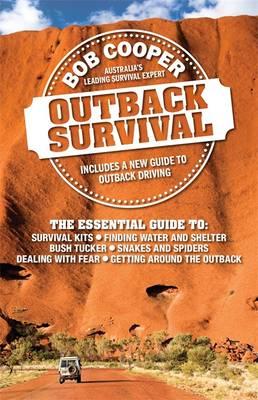 NEW: Outback Survival, by Bob Cooper. From the publisher: NEW: Outback Survival, by Bob Cooper. From the publisher:
Australia has, without question, some of the harshest conditions on Earth, with a host of wildlife and plants that can be both friend and foe in time of need. Our massive tourism industry is constantly searching for ways to make travel in these conditions safe, but the news regularly features people who have underestimated the wilderness.
This new guide from a world-renowned expert holds the keys to survival and safety when faced with such a serious scenario. 2nd Edition released 20th December 2016 Contains updated information and a whole new chapter with useful tips for off road driving.
The new edition Outback Survival, now with outback driving guide, tells you everything you need to know to survive in the outback.
Bob Cooper's incredible bushcraft skills have been developed through more than 30 years of experience in Australia's harsh outback. He has picked up tools of survival from the experiences of living with traditional Aboriginal communities, instructing Special Forces units, lecturing with the Texas Parks and Wildlife Service on desert survival in the Mexican Desert, delivering wilderness lessons in the UK and learning the skills of the bushmen of the Kalahari Desert in Botswana.
Bob has put his own lessons to the test and showed that with the right knowledge of the land, you can survive in even the harshest of conditions. Outback Survival tells you WHAT you need to do, and HOW, if you want to survive. Based on Bob's Big 5 techniques, he explains:
WATER - how to find, purify and transport
WARMTH - fire and wind-proofing
SHELTER - against rain, cold, wind and sun
SIGNALS - by day and night
FOOD - foraging and fishing
This new edition also features Bob's Outback Driving guide.
The outback of Australia is one of the most unforgiving regions of the world, but Bob Cooper is committed to protecting and enhancing the experience people have when venturing out into the bush.
'a guidebook that might just save your life' - HERALD SUN
Purchase from Amazon Australia |
See also Aboriginal Studies further down on this page.
Bush Tucker
|
 The Weed Forager’s Handbook, Adam Grubb and Annie Raser-Rowland. This is the best Australian book on edible weeds that's currently in print that I know of. Most of the book is about the author's top 20 edible weeds, with each weed getting a few pages that include detailed photos and drawings for identification. First published in 2012. The Weed Forager’s Handbook, Adam Grubb and Annie Raser-Rowland. This is the best Australian book on edible weeds that's currently in print that I know of. Most of the book is about the author's top 20 edible weeds, with each weed getting a few pages that include detailed photos and drawings for identification. First published in 2012.
"Step into the world of our least admired botanical companions, peel back the layers of prejudice, and discover the finer side of the plants we call weeds. This book reveals how to distinguish a tasty sandwich-filler from its dangerous look-alike, which weeds are among the most nutritious vegetables ever tested, and how you cook with delicious nettles without fear of being stung ...It will forever change your concept of where to go looking for lunch."
Purchase from Australia (Booktopia)
Purchase from Australia (Angus & Robertson)
Purchase from Australia (The Nile)
Click here to purchase from Australia (Fishpond)
Purchase from Amazon |
|
 NEW: Field Guide to Useful Native Plants from Temperate Australia, by Caton J. M. & Hardwick R. J. This is a new book (published August 2016) which I haven't got yet but it looks to be very good. I've got it now, and it is really good. There are colour photos of the plants from a distance (so you can see the whole plant), and separate photos close-up of particular parts of the plants. NEW: Field Guide to Useful Native Plants from Temperate Australia, by Caton J. M. & Hardwick R. J. This is a new book (published August 2016) which I haven't got yet but it looks to be very good. I've got it now, and it is really good. There are colour photos of the plants from a distance (so you can see the whole plant), and separate photos close-up of particular parts of the plants.
From the publishers,
The result of a 15-year fieldwork partnership photographing, describing and using plants from the temperate eco-regions of Australia. A valuable contribution to the knowledge of the native plants of Australia.
- Detailed descriptions of over 150 useful plants from the temperate eco-region.
- More than 600 colour photos and drawings for ease of identification, as well as maps of local and Australia-wide distributions.
- Information on a wide range of uses for native plants as food, fibre and medicines, including notes on preparation.
Unfortunately this book (as of mid-2024) is very difficult to find a copy of.
|
|
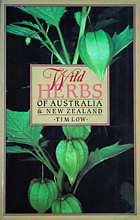 Wild Herbs of Australia and New Zealand,
Tim Low. The best book I have seen about edible/medicinal "weeds"—which
are usually introduced plants, the kind that grow between the grass
in your suburban garden
and along the railway tracks. See my weeds page.
It is not the best book for learning to identify the weeds, though,
although it is okay.
Black and white line drawings of the plants, no colour pictures.
You would be better off with another book to identify the weeds,
and
this book
to learn
what
to
do with
them.
This book
contains
an
excellent description of the different types of plant toxins. Note that there are a few plants included that it could be debated whether they are really edible. Out
of print. Wild Herbs of Australia and New Zealand,
Tim Low. The best book I have seen about edible/medicinal "weeds"—which
are usually introduced plants, the kind that grow between the grass
in your suburban garden
and along the railway tracks. See my weeds page.
It is not the best book for learning to identify the weeds, though,
although it is okay.
Black and white line drawings of the plants, no colour pictures.
You would be better off with another book to identify the weeds,
and
this book
to learn
what
to
do with
them.
This book
contains
an
excellent description of the different types of plant toxins. Note that there are a few plants included that it could be debated whether they are really edible. Out
of print.
Click here to look for it on Amazon (secondhand only) |
|
 How can I be prepared with Self-Sufficiency and Survival Foods, Isabell Shipard. I have not had this book very long but I am very impressed with it. It covers a great many of the topics discussed on survival.ark.au and covers them quite well. There are 16 pages (large A4 pages, with small writing) devoted to edible weeds, including colour photos of many of the weeds. Apart from edible weeds it also covers a few bush tucker (native) food plants, survival kits, storing food, permaculture, sprouting, herbs, and more. Her Course on DVD (PAL format) looks like it would also be excellent, though I have not seen it yet. How can I be prepared with Self-Sufficiency and Survival Foods, Isabell Shipard. I have not had this book very long but I am very impressed with it. It covers a great many of the topics discussed on survival.ark.au and covers them quite well. There are 16 pages (large A4 pages, with small writing) devoted to edible weeds, including colour photos of many of the weeds. Apart from edible weeds it also covers a few bush tucker (native) food plants, survival kits, storing food, permaculture, sprouting, herbs, and more. Her Course on DVD (PAL format) looks like it would also be excellent, though I have not seen it yet.
Click here to purchase from Australia (Fishpond)
Click here to purchase from Isabell's Site (Australian)
|
|
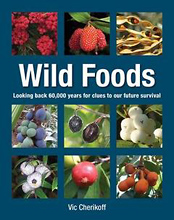
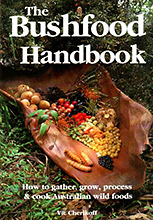 The Bushfood Handbook, Vic Cherikoff. This is more
of a reading book than a field guide, and also has a bit about commercial
bushfood
industry and gourmet recipes, but still does have some very very good
stuff in it. Like Tim Low's Books it is not focused on the north
only (there is lots of stuff about the sydney region). There are tables in the back, and other sections throughout the book that contain a lot of really useful information, like what wattle seeds you can eat, and so on. The Bushfood Handbook, Vic Cherikoff. This is more
of a reading book than a field guide, and also has a bit about commercial
bushfood
industry and gourmet recipes, but still does have some very very good
stuff in it. Like Tim Low's Books it is not focused on the north
only (there is lots of stuff about the sydney region). There are tables in the back, and other sections throughout the book that contain a lot of really useful information, like what wattle seeds you can eat, and so on.
A large all-colour
book, probably the best "reading" book I have seen on bush
tucker, and overall one of the three or four best bush tucker books that there is. Seems to be out of print unfortunately.
Click here to purchase from Amazon (probably secondhand only)
|
|
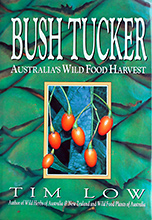 Bush Tucker: Australia's Wild Food Harvest, Tim Low. A large, hardcover book with
colour pictures (actually most of these books have colour pictures).
A very good
"reading" book, perhaps my favourite (the other contender
would be Vic Cherikoff's book above). Out of print. Bush Tucker: Australia's Wild Food Harvest, Tim Low. A large, hardcover book with
colour pictures (actually most of these books have colour pictures).
A very good
"reading" book, perhaps my favourite (the other contender
would be Vic Cherikoff's book above). Out of print.
Click here to purchase from Amazon (secondhand only)
|
|
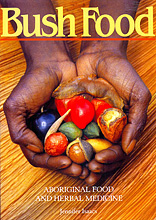
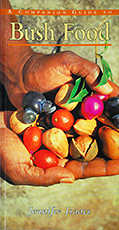 A Companion Guide to Bush Food, Jennifer Isaccs. A
summarised version of the book above, small and light, but I would
not really
call it
a field guide. It was the first bush tucker book that I read all the way through from front to back. If you want to read one all the way through, this would be a good choice since there is less to read than most of the other books, and it gives you a good overview. There is some bias to the North of Australia but Southern plants are also featured. A Companion Guide to Bush Food, Jennifer Isaccs. A
summarised version of the book above, small and light, but I would
not really
call it
a field guide. It was the first bush tucker book that I read all the way through from front to back. If you want to read one all the way through, this would be a good choice since there is less to read than most of the other books, and it gives you a good overview. There is some bias to the North of Australia but Southern plants are also featured.
Click here to look for it on Amazon (secondhand only) |
|
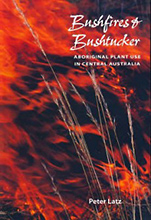 Bushfires and Bushtucker, Peter Latz. This is the larger version of the book below, reprinted in 2005. It focuses on the arid regions (i.e. central Australia). It contains multiple colour photographs and scale line drawings for each plant including fruit, seed, form and habitat. Bushfires and Bushtucker, Peter Latz. This is the larger version of the book below, reprinted in 2005. It focuses on the arid regions (i.e. central Australia). It contains multiple colour photographs and scale line drawings for each plant including fruit, seed, form and habitat.
Purchase from Australia (Probably unavailable)
Used on Amazon |
|
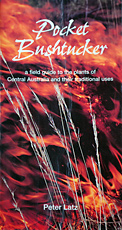 Pocket Bushtucker, Peter Latz. This is a nice field
guide, but only focuses on the arid regions. Mostly black and white
line drawings with a few colour photos. It was the first bush food book I found
(and therefore bought). It would be good to take on a trip to the
interior but is not so useful in the Southeast. There is a larger
version of it also
(like the Jennifer Isaacs books) which I do not have, but I have borrowed it from the library. It lives up to its name, Pocket Bushtucker, being the smallest field guide that I have, and very easy to carry around. Pocket Bushtucker, Peter Latz. This is a nice field
guide, but only focuses on the arid regions. Mostly black and white
line drawings with a few colour photos. It was the first bush food book I found
(and therefore bought). It would be good to take on a trip to the
interior but is not so useful in the Southeast. There is a larger
version of it also
(like the Jennifer Isaacs books) which I do not have, but I have borrowed it from the library. It lives up to its name, Pocket Bushtucker, being the smallest field guide that I have, and very easy to carry around.
Click here to look for it on Amazon (secondhand only) |
|
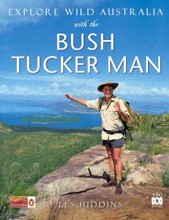
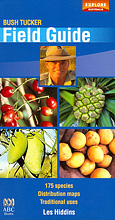 Bush Tucker Field Guide, Les Hiddins. A much smaller
book containing the bush tucker list from the above book, by the famous "Bush Tucker Man". Quite good,
but like his larger book (see above) it really only covers the North of Australia. If you don't live in the North, get Tim Low's Field Guide instead.
Bush Tucker Field Guide, Les Hiddins. A much smaller
book containing the bush tucker list from the above book, by the famous "Bush Tucker Man". Quite good,
but like his larger book (see above) it really only covers the North of Australia. If you don't live in the North, get Tim Low's Field Guide instead.
I was given this for Christmas one year and by good luck it happened to be basically the only current Australian bush tucker book that I didn't already own (I even had the larger version of this book listed above).
Click here to purchase from Amazon Australia (Might be expensive)
Click here to purchase from Australia (The Nile) (Seems to be unavailable)
|
|
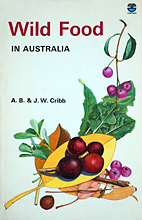 Wild Food in Australia, A. B. and J. W. Cribb. William
Collins Publishers, 1974. Older style book with the colour pictures
on separate colour
"plates", and the text on black and white-only pages. A
pretty good book though (apart from not having the pictures of the
plants close
to the text, which I find quite annoying). I bought mine for $12
from a second-hand shop. Wild Food in Australia, A. B. and J. W. Cribb. William
Collins Publishers, 1974. Older style book with the colour pictures
on separate colour
"plates", and the text on black and white-only pages. A
pretty good book though (apart from not having the pictures of the
plants close
to the text, which I find quite annoying). I bought mine for $12
from a second-hand shop.
Click here to look for it on Amazon (secondhand only) |
Bush Tucker, A Guide to, and Resources on Traditional Aboriginal
Foods of the North West of S. A. and Central Australia, Cathy Winfield. Mimili
Aboriginal School, North West South Australia, and Wattle Park Teachers
Centre, 1982, Reprinted 1985, 1986, 1987. This is a
black and white booklet that has been printed on A4 paper, rather
than published as such as an actual "book". It contains a list of
the most common animals and plants eaten in the traditional diet
of central Australia. Each food source is described on a page with
a description, black and white drawing, and its uses.
|
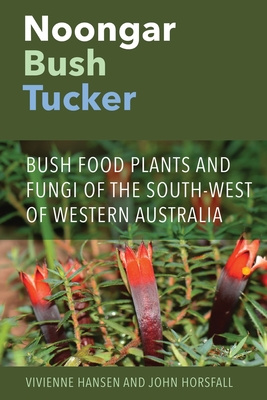 NEW: Noongar Bush Tucker: Bush Food Plants and Fungi of the South-West of Western Australia, by Vivienne Hansen and John Horsfall.
 A rare Australian bush tucker book that features plants, and even fungi also, from the south-west of Western Australia. Most of the bush tucker books available focus on the southeastern regions of Australia, or the arid centre, or the tropical north. It's got lots of large photos and good desriptions. The paper is a matte style (i.e. not glossy) and smells like it's eco-friendly paper (I like the smell of it).
Purchase from Amazon.com.au (Australian Site)
|
Medicinal Plants
|
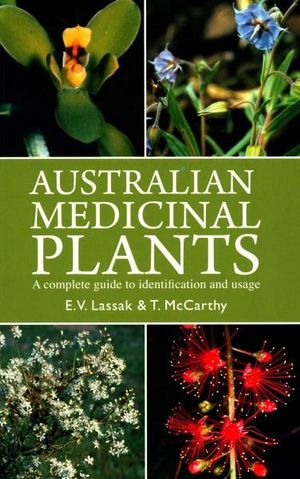 NEW: Australian Medicinal Plants: A Complete Guide to Identification and Usage, by Lassak E. V. and McCarthy, T.
 I've just discovered this one. From the publisher, "An essential guide and invaluable resource for anyone interested in herbal medicine, Australian flora and the indigenous Australian culture. Plants have been used for medicinal purposes since earliest recorded history and Australia's varied flora provided Aboriginal people with medicines.
With the arrival of Europeans much of this knowledge was overtaken by modern drugs and techniques but today there is a revival of interest in traditional medicines. Australian Medicinal Plants covers the Aboriginal use of native plants and explains how the first settlers learned from the Aborigines their medicinal values.
There is information on nearly 500 individual plants, how they were used, what their known pharmacological constituents are, where to find them and how to prepare remedies. The species are helpfully arranged in chapters according to their use: for fevers, painkillers, antiseptics and digestive disorders for instance."
Purchase from Australia (The Nile)
Purchase from Australia (Fishpond) (Probably Unavailable)
Purchase from Amazon.com.au (Australian Site)
|
|
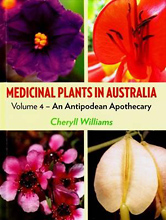 NEW: Medicinal Plants in Australia, Volume 4 — An Antipodean Apothecary, Cheryll Williams. Now there is a 4th volume of this excellent series. NEW: Medicinal Plants in Australia, Volume 4 — An Antipodean Apothecary, Cheryll Williams. Now there is a 4th volume of this excellent series.
Click here to look for it Amazon Australia (Likely to be available, might be expensive)
|
|
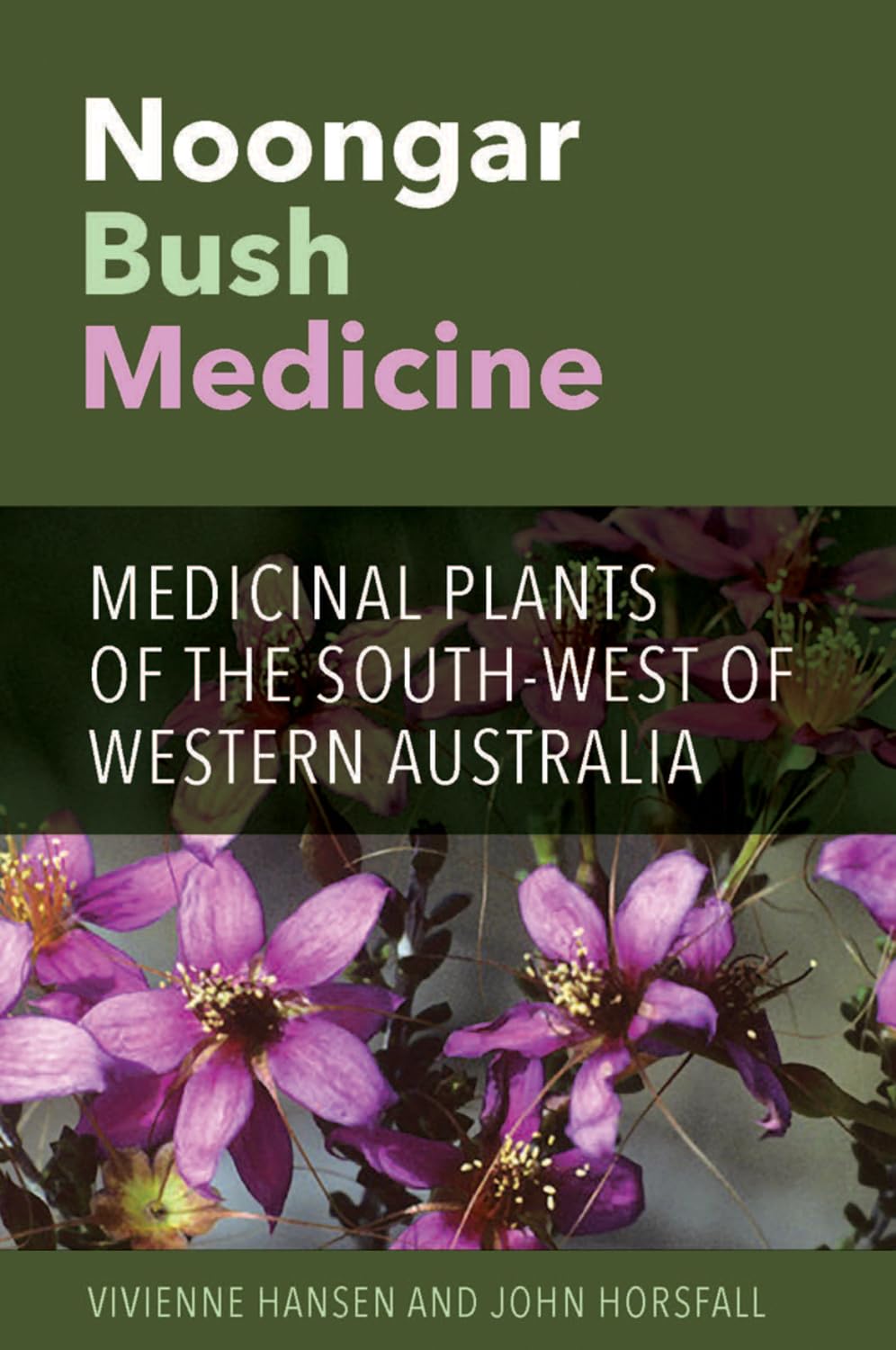 NEW: Noongar Bush Medicine: Medicinal Plants of the South-West of Western Australia, by Vivienne Hansen and John Horsfall.
 From the publisher, "Noongar Bush Medicine provides for the first time a comprehensive information on the the medicinal plants that were used by Aboriginal people of the south-west of Western Australia before European settlement. The book is a guide to how to use plants for alternative treatments and protection from common ailments."
Purchase from Amazon.com.au (Australian Site)
|

Aboriginal Studies
|
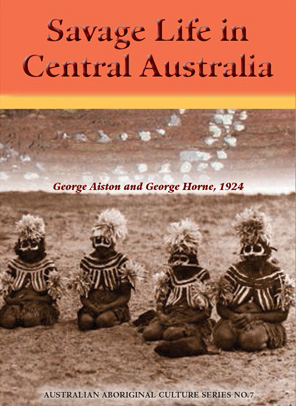 NEW: Savage Life in Central Australia, by George Aiston and George Horne. Originally published in 1924. Republished in 2009 with additional text and photographs by Don Rowlands and David M. Welch. 230 pages. A detailed description of many aspects of traditional life in Central Australia. Back then the words used by white people were different, and some words now considered to be demeaning (such as "savage") were used freely. I bought it from the shop attached to the Australian Museum in Sydney. It's number 7 of the Australian Aboriginal Culture Series, published by David M. Welch. NEW: Savage Life in Central Australia, by George Aiston and George Horne. Originally published in 1924. Republished in 2009 with additional text and photographs by Don Rowlands and David M. Welch. 230 pages. A detailed description of many aspects of traditional life in Central Australia. Back then the words used by white people were different, and some words now considered to be demeaning (such as "savage") were used freely. I bought it from the shop attached to the Australian Museum in Sydney. It's number 7 of the Australian Aboriginal Culture Series, published by David M. Welch.
View 1924 edition on Google Books (free)
Read about on David M. Welch's website
Look for it on Amazon
|
|
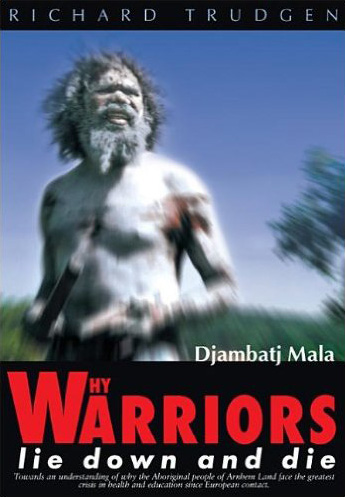 NEW: Why Warriors Lie Down and Die, by Richard Trudgen. First published in 2000 and reprinted many times. Proceeds from the sale of this book will go towards sponsoring community development and community education work with Indigenous peoples. NEW: Why Warriors Lie Down and Die, by Richard Trudgen. First published in 2000 and reprinted many times. Proceeds from the sale of this book will go towards sponsoring community development and community education work with Indigenous peoples.
Detailed account of cutural and other problems faced by Aboriginal people. From the publisher, "Why Warriors Lie Down and Die is essential reading for anyone interested in Indigenous peoples. It offers deep insights for those who want a greater understanding of the issues involved in achieving true reconciliation, and provides hope and new direction for those searching for the answers as to why “the problems” seems to persist in Aboriginal communities. In Arnhem Land, as in Indigenous communities across Australia, the situation is dire. Indigenous health in Australia is now so bad that 45% of Aboriginal men and 34% of women die before the age of 45. Aboriginal and Torres Strait Islander people are also massively over-represented in the criminal justice system. Western Australia incarcerates the Aboriginal peoples of its State at 9 times the rate of Apartheid South Africa"
“Many books have been written about the Yolngu people of Arnhem Land, Australia. This one is very different. It speaks about the real situation that we face every day, a reality that is hard for people of another culture to imagine.” Rev. Dr. Djiniyini Gondarra OAM,
Yolngu Clan Elder.
Purchase from Amazon Australia
Why Warriors website
Purchase from Amazon USA (mostly secondhand)
|
|
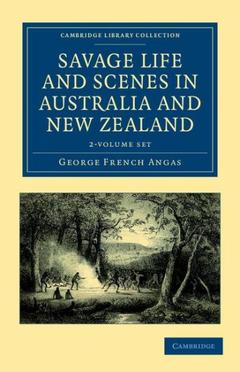 NEW: Savage Life and Scenes in Australia and New Zealand: Being an Artist's Impressions of Countries and People at the Antipodes, by George French Angas. NEW: Savage Life and Scenes in Australia and New Zealand: Being an Artist's Impressions of Countries and People at the Antipodes, by George French Angas.
George French Angas (1822-86) gave up a career in business to become an artist, and his interest in natural history and ethnology is apparent throughout his work. In the early 1840s he travelled to Australia and New Zealand, where he took part in two expeditions in South Australia and later walked nearly 800 miles through the volcanic interior of North Island with Maori guides, sketching at every opportunity. His paintings from this period were later exhibited and formed the basis of two important large-format books of lithographs that appeared in 1849, having been announced in this two-volume 1847 account of his travels.
The book contains vivid descriptions of his experience, and focuses especially on the way of life of the indigenous peoples of South Australia, New South Wales and New Zealand. It also describes the spectacular landscapes and exotic flora and fauna he observed throughout the trip.
This is not the collection of paintings — these two volumes contain a few paintings and mostly written descriptions of life.
Purchase from Amazon Australia (Likely to be available)
View online or download Volume 1 from archive.org (free)
View online or download Volume 1 from Google Books (free)
View online or download Volume 2 from Google Books (free)
|
|
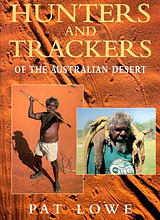 Hunters and Trackers of the
Australian Desert, Pat Lowe. This is more of
a "reading" book
than a "how to" book, but its pretty good. They sell it
at Australian Geographic shops so if you are at one you can decide
if
its worth getting. It's about Aboriginal hunting and other skills and practices, with a fair bit about tracking. At one point in the story they ask the author if she likes cats, to which she replies "Oh, yes, I like them very much" — so they cook one up for her. (In the outback, feral cats cause a huge amount of destruction.) Hunters and Trackers of the
Australian Desert, Pat Lowe. This is more of
a "reading" book
than a "how to" book, but its pretty good. They sell it
at Australian Geographic shops so if you are at one you can decide
if
its worth getting. It's about Aboriginal hunting and other skills and practices, with a fair bit about tracking. At one point in the story they ask the author if she likes cats, to which she replies "Oh, yes, I like them very much" — so they cook one up for her. (In the outback, feral cats cause a huge amount of destruction.)
Purchase from Amazon Australia (Might be expensive)
Purchase from The Nile Australia (Probably Unavailable)
Used on Amazon
|
|
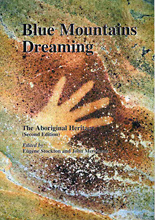 Blue Mountains Dreaming: The Aboriginal Heritage, ed. by
Eugene Stockton. This has a scientific flavour to it, and has chapters about
customs and lifestyles, archaeology, stone tools, food and diet.
There is a list of about 75 plant foods that
I have typed up and printed and am learning. There is a new edition of it in a larger format (pictured), that you can find in some bookstores (a lot of places in the Blue Mountains sell it). The newer edition is rather expensive, about $60 new (update - it seems to be cheaper now), and has some colour plates, where the original edition was only black and white and only cost about $20 or $25 new. Blue Mountains Dreaming: The Aboriginal Heritage, ed. by
Eugene Stockton. This has a scientific flavour to it, and has chapters about
customs and lifestyles, archaeology, stone tools, food and diet.
There is a list of about 75 plant foods that
I have typed up and printed and am learning. There is a new edition of it in a larger format (pictured), that you can find in some bookstores (a lot of places in the Blue Mountains sell it). The newer edition is rather expensive, about $60 new (update - it seems to be cheaper now), and has some colour plates, where the original edition was only black and white and only cost about $20 or $25 new.
Click here to look for it on Amazon (1st edition, secondhand)
|
|
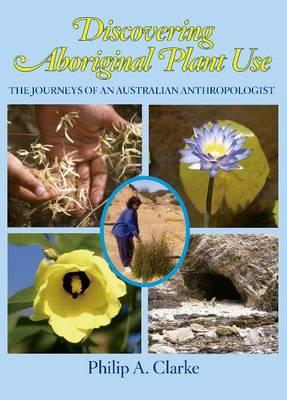
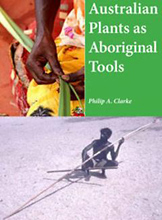 NEW: Australian Plants as Aboriginal Tools, by Philip A. Clarke. Like Philip Clarke's other book above, this is a great book, a large colour "reading" book rather than a field guide. It contains a lot of information. NEW: Australian Plants as Aboriginal Tools, by Philip A. Clarke. Like Philip Clarke's other book above, this is a great book, a large colour "reading" book rather than a field guide. It contains a lot of information.
Purchase or read reviews on Amazon.com.au
|
|
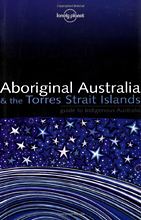 Lonely Planet: Aboriginal Australia & the Torres Strait Islands
— Guide to Indigenous Australia. 1st ed. July 2001. This was out of print for ages, but last time I looked there were some secondhand copies of it on Amazon. It is a unique book (as far as I know), a traveller's guide to the remote areas of Australia and also a listing of Indigenous-related sites and places that you can visit all over Australia. Lonely Planet: Aboriginal Australia & the Torres Strait Islands
— Guide to Indigenous Australia. 1st ed. July 2001. This was out of print for ages, but last time I looked there were some secondhand copies of it on Amazon. It is a unique book (as far as I know), a traveller's guide to the remote areas of Australia and also a listing of Indigenous-related sites and places that you can visit all over Australia.
Click here to look for it on Amazon
Try here new or used (Fishpond) |
Poisonous Plants and Animals
Jon Young says to learn the poisonous/dangerous plants and animals in your area (or the wilderness area that you are going to be going out in) first.
Pretty But Poisonous, R.C.H. Shepherd. An excellent book covering the types of plants that you are likely to find growing in your garden,
not so much the native ones that you will find in the bush.
You can get it here (Link working in mid-2024).
Some Plants are Poisonous, Sally Wilson. Until I found the book above this was
about the only decent book about poisonous plants I have been able
to find for australia.
(Please let me know if you know of any
others). This book is hard to find. (Again let me know if you find
a source for it).
Poisonous plants of Australia, Selwyn L. Everist. This is
a very large book that goes for about $300
secondhand, and is far too big and serious for casual use, its at
my local library.
Most
of
the (few) books on poisonous plants are focused on livestock poisoning. 684 large pages. It's the bible of poisonous plants for Australia. Click here to look for it on Amazon.
Toxic Plants and Animals, A Guide for Australia, ed. by
Jeanette Covacevich, Peter Davie and John Pearn. The plants
section takes up 70 of the 504 pages of this book, so it is mostly
about animals.
It is fairly technical, and out of print.
Australia's Dangerous Creatures — Understand, Identify,
Avoid, Survive, Reader's Digest. A large colour book,
I found it for $6 secondhand and at that price very much well worth
it.
Plants
|
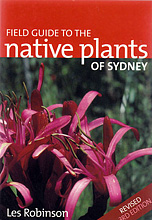 Field Guide to the Native Plants of Sydney, Les Robinson. Revised 3rd edition, 2003. Kangaroo Press, Sydney. Great book for comprehensive, strict and technical descriptions of the plants. Perhaps the best technical small field guide if you don't mind line drawings. (The book below is thicker and has colour pictures.) Has no photos, only black and white line drawings. Contains a lot of species (over 1370) and an excellent key to identification in the front of the book.
Purchase or read reviews on Amazon.com.au
Click here to purchase from Australia (The Nile)
Purchase from Amazon (US) |
|
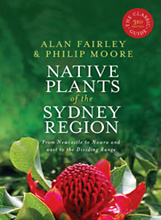 Native Plants of the Sydney Region, Alan Fairley and Philip Moore. This is really good. Nearly 1400 species in 624 pages (but not large pages). The authors also wrote "Native Plants of the Sydney District" which was one of the best (if not the best) plant books I have seen for Sydney. It was a large, expensive (well over $100 new) hardcover book that you will probably pay at least $200 for secondhand now. This new one is softcover and less than half the price. Perhaps the best overall book for the Sydney region that's small enough to carry. Lots of colour photos. Native Plants of the Sydney Region, Alan Fairley and Philip Moore. This is really good. Nearly 1400 species in 624 pages (but not large pages). The authors also wrote "Native Plants of the Sydney District" which was one of the best (if not the best) plant books I have seen for Sydney. It was a large, expensive (well over $100 new) hardcover book that you will probably pay at least $200 for secondhand now. This new one is softcover and less than half the price. Perhaps the best overall book for the Sydney region that's small enough to carry. Lots of colour photos.
Purchase or read reviews on Amazon.com.au
Click here to purchase from Australia (The Nile) with free shipping in Australia
Purchase from Amazon (US) |
|
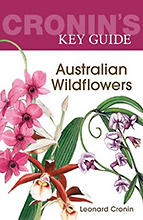
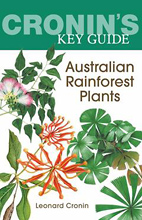 NEW: Cronin's Key Guide to Australian Rainforest Plants, Leonard Cronin. Another in the Cronin's key guide series, on rainforest plants. NEW: Cronin's Key Guide to Australian Rainforest Plants, Leonard Cronin. Another in the Cronin's key guide series, on rainforest plants.
Purchase from Amazon Australia
|
|
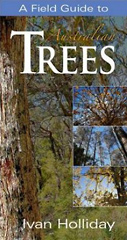 A Field Guide to Australian Trees, Ivan Holliday. Small, portable
book with trees grouped by their genus and colour photographs of
the whole tree from a distance. Black and white line drawings are
given of other identifying parts of the trees, such as leaves or
fruit. Contains a lot of trees (about 400). Good to take in the car when you are going on road trips. A Field Guide to Australian Trees, Ivan Holliday. Small, portable
book with trees grouped by their genus and colour photographs of
the whole tree from a distance. Black and white line drawings are
given of other identifying parts of the trees, such as leaves or
fruit. Contains a lot of trees (about 400). Good to take in the car when you are going on road trips.
Look on Amazon Australia |
The Random House Encyclopedia of Australian Native Plants,
Geoff Bryant. Large book with about 2000 plants described, and 550 colour
photographs. The plants are grouped by their genus.
|
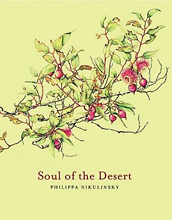 Soul
of the Desert, Philippa Nikulinsky and Stephen D Hopper. It's
not a field guide, its a large, beautiful book, with lovely hand-painted
pictures of plants (mostly) and some animals from the central deserts
of australia, with descriptions of them. The best thing about this
book is that somehow it makes you feel very connected to the subject
matter, which is in contrast to many
field guides (especially plant ones) that can be somewhat
overwhelming or even alienating to beginners. If you live in
the centre of Australia, I would say definitely get this book. Soul
of the Desert, Philippa Nikulinsky and Stephen D Hopper. It's
not a field guide, its a large, beautiful book, with lovely hand-painted
pictures of plants (mostly) and some animals from the central deserts
of australia, with descriptions of them. The best thing about this
book is that somehow it makes you feel very connected to the subject
matter, which is in contrast to many
field guides (especially plant ones) that can be somewhat
overwhelming or even alienating to beginners. If you live in
the centre of Australia, I would say definitely get this book.
Purchase from Amazon Australia
Purchase from Australia (The Nile) (Probably unavailable) (free shipping)
Click here to purchase from Amazon |
|
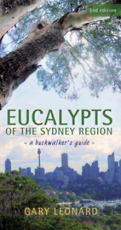 Eucalypts of the Sydney Region — A Bushwalker's Guide, Gary Leonard. A
small colour book with the most common Eucalypts ("gum trees") found within 100
kilometres of
Sydney and how to identify them. There are something like 700 species
of Eucalypts in Australia and learning to identify them can be
quite difficult. This book would be a good place to start. It's only a small book but there aren't many books just on eucalypts. Eucalypts of the Sydney Region — A Bushwalker's Guide, Gary Leonard. A
small colour book with the most common Eucalypts ("gum trees") found within 100
kilometres of
Sydney and how to identify them. There are something like 700 species
of Eucalypts in Australia and learning to identify them can be
quite difficult. This book would be a good place to start. It's only a small book but there aren't many books just on eucalypts.
Amazon Australia
Click here to purchase from Australia (Fishpond) (In stock during June 2024)
Click here to purchase from Australia (The Nile) (In stock during June 2024) |
Weeds
|
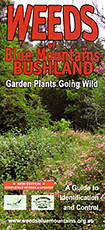 Weeds of Blue Mountains Bushland — Garden
Plants Going Wild, Blue Mountains City Council, National Parks and
Wildlife Service, and Sydney Catchment Authority. A 45 page colour
pamphlet with details of the most common introduced weeds found in
the Blue Mountains. Most (or all?) of these weeds are also found in Sydney and many other parts of Australia. Weeds of Blue Mountains Bushland — Garden
Plants Going Wild, Blue Mountains City Council, National Parks and
Wildlife Service, and Sydney Catchment Authority. A 45 page colour
pamphlet with details of the most common introduced weeds found in
the Blue Mountains. Most (or all?) of these weeds are also found in Sydney and many other parts of Australia.
It is available free by phoning the council on (02) 4780 5528,
they will even post it out to you, although you may need to be a
resident of the Blue Mountains.
You can also view the weeds here for free from the Weeds of the Blue Mountains website. It used to be available online as a PDF, but that seems to be gone from their website now. |
|
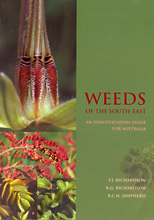 Weeds of the South-East — An Identification Guide for Australia, F. J. Richardson, R. G. Richardson, and R. C. H. Shepherd. An excellent book on identifying (mostly introduced) weeds. The best weeds book I have seen that is still in print. Over 2000 species and 1600 colour photos. Its expensive but its the best weeds book ever (well pretty much). Weeds of the South-East — An Identification Guide for Australia, F. J. Richardson, R. G. Richardson, and R. C. H. Shepherd. An excellent book on identifying (mostly introduced) weeds. The best weeds book I have seen that is still in print. Over 2000 species and 1600 colour photos. Its expensive but its the best weeds book ever (well pretty much).
It seems to be out od stock everywhere as of July 2024. |
There are a couple more weeds books listed under Bush Tucker
Fungi
|
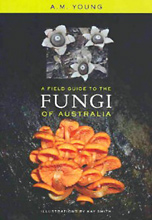 A Field Guide to the Fungi of Australia, Tony Young and A.M. Young. This is the best field guide to Australian Fungi that I have seen. Note that it is extremely dangerous to eat fungi if there is any doubt whatsoever that you have an edible species. There are many stories of people — even a fungi expert and his family— around the world who died from eating fungi that they mistook for a different species. I would recommend you don't eat any wild growing mushroom or fungus. Its's just not worth the risk. Even if the risk is only small. They don't have many calories anyway.
Purchase from Amazon Australia
Purchase from Australia (The Nile) (no longer available NO it's back now, still there in June 2024)
Purchase from Amazon USA |
Mammals
|
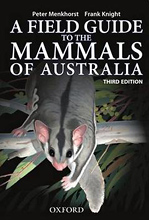 A Field Guide to the Mammals of Australia, Peter Menkhorst and Frank Knight. This is my favourite mammal guide (I have the 2nd and 3rd editions), it has all the mammals, even the introduced ones. Frank knight also illustrated the famous bird guide "Pizzey and Knight". It even has track information on the inside of the rear cover. The only thing I don't like about this book is the strong smell of the cover of the 2nd edition, that is probably vinyl chloride or something like that, which is a carcinogen. The 3rd edition cover doesn't have the vinyl chloride.
Purchase from Amazon Australia
Click here to purchase 3rd ed. from Australia (The Nile)
Purchase from Amazon USA |
|
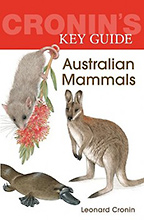 Cronin's Key guide to Australian Mammals, Leonard Cronin. This is a nice book, and I like the pictures a lot. It doesn't have
all the mammal species, but almost all of them, and it has good information. It was the first mammal field guide that I bought and I like it a lot. The pictures/drawings of the mammals seem really friendly-looking
Cronin's Key guide to Australian Mammals, Leonard Cronin. This is a nice book, and I like the pictures a lot. It doesn't have
all the mammal species, but almost all of them, and it has good information. It was the first mammal field guide that I bought and I like it a lot. The pictures/drawings of the mammals seem really friendly-looking
Purchase from Amazon Australia
Click here to purchase from Australia (The Nile) |
|
 Tracks, Scats and Other Traces: A Field Guide to Australian
Mammals, Barbara Triggs. Oxford University Press, 1996. (Third Edition, 2005).
Not your usual mammals field guide with
pictures of each animal and a description of them. Instead it has
pictures of the tracks, the scats (droppings), the skulls and other
bones, and other kinds of traces such as scratchings on trees.
In other words, the things that you see that the animals have left
behind. Which in the case of most of Australian mammals, being
nocturnal, that is all you actually see of the animal. Very highly recommended!
Tracks, Scats and Other Traces: A Field Guide to Australian
Mammals, Barbara Triggs. Oxford University Press, 1996. (Third Edition, 2005).
Not your usual mammals field guide with
pictures of each animal and a description of them. Instead it has
pictures of the tracks, the scats (droppings), the skulls and other
bones, and other kinds of traces such as scratchings on trees.
In other words, the things that you see that the animals have left
behind. Which in the case of most of Australian mammals, being
nocturnal, that is all you actually see of the animal. Very highly recommended!
Purchase from Amazon Australia
Click here to purchase from Australia (The Nile) |
|
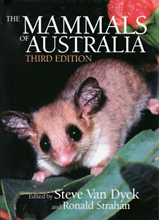 The Mammals of Australia, Ronald Strahan and Steve van Dyck. Third Edition, 2006.
This is a truly lovely book, with a huge amount of information in its 888 pages. It has every mammal species plus the introduced ones (like the rabbit, hare, fox, etc.). I had my eye on it for years and then recently I was lucky enough to find a 2nd edition one for sale for $30 at a library, presumably because they had updated to the 3rd edition.
The Mammals of Australia, Ronald Strahan and Steve van Dyck. Third Edition, 2006.
This is a truly lovely book, with a huge amount of information in its 888 pages. It has every mammal species plus the introduced ones (like the rabbit, hare, fox, etc.). I had my eye on it for years and then recently I was lucky enough to find a 2nd edition one for sale for $30 at a library, presumably because they had updated to the 3rd edition.
Purchase from Amazon Australia
Click here to purchase from Australia (The Nile) (Probably unavailable) |
|
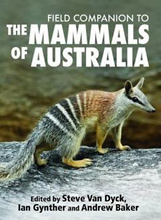 NEW: Field Companion to the Mammals of Australia, edited by Steve Van Dyck, Ian Gynther and Andrew Baker. 2012.
This is another really good field guide based on the above large book. It's more technical than Menkhorst & Knight or Cronin's one. 573 pages. It's a contender for best overall mammals field guide. I'd say its the best one if detailed technical information about identification is more important than descriptions about the animals habits and behaviour etc.
NEW: Field Companion to the Mammals of Australia, edited by Steve Van Dyck, Ian Gynther and Andrew Baker. 2012.
This is another really good field guide based on the above large book. It's more technical than Menkhorst & Knight or Cronin's one. 573 pages. It's a contender for best overall mammals field guide. I'd say its the best one if detailed technical information about identification is more important than descriptions about the animals habits and behaviour etc.
Purchase or read reviews on Amazon.com.au
|
Birds
|
 NEW: The Australian Bird Guide, by Peter Menkhorst (Author), Danny Rogers (Author), Rohan Clarke (Author), Jeff Davies (Illustrator), Peter Marsack (Illustrator), Kim Franklin (Illustrator).
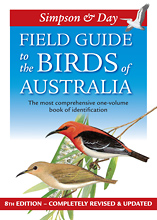
 Revised Edition 2019. Original edition published 2017. This is a newer Australian bird field guide that I just got recently. It may be the best one out of all of them now. Though I still like the pictures better in "Simpson and Day" in terms of their artistic value, and that they just look more interesting to me than the drawings in any other bird field guide I've seen. This one has more "clinical" looking pictures. They are coloured artist-rendered drawings, not photographs. Though the more "clinical" look is meant to be more anatomically accurate, and better for identification.
The rest of the book is wonderful, with different coloured regions on the range maps, and very high quality information overall. It was the winner in its category for an Australian Book Industry Awards (ABIA) award for book of the year in 2018.
Purchase from Australia (The Nile)
Purchase from Australia (Fishpond)
Purchase from Amazon.com (USA Site)
Purchase from Amazon.com.au (Australian Site)
|
|
 NEW: Birds of Australia: A Photographic Guide, by Iain Campbell, Sam Woods, Nick Leseberg, Geoff Jones (Photographer).
 I bought this field guide recently (June 2020). As the name suggests, it's got photographs rather than line drawings. They are very high quality, clear photos. I've got so many field guides now, they have to be really good before I buy them (I got it from a physical book shop, so I was able to look through it thoroughly before deciding whether or not to get it).
From the publisher:
Australia is home to a spectacular diversity of birdlife, from parrots and penguins to emus and vibrant passerines. Birds of Australia covers all 714 species of resident birds and regularly occurring migrants and features more than 1,100 stunning color photographs, including many photos of subspecies and plumage variations never before seen in a field guide. Detailed facing-page species accounts describe key identification features such as size, plumage, distribution, behavior, and voice. This one-of-a-kind guide also provides extensive habitat descriptions with a large number of accompanying photos. The text relies on the very latest IOC taxonomy and the distribution maps incorporate the most current mapping data, making this the most up-to-date guide to Australian birds.
- Covers all 714 species of resident birds and regularly occurring migrants
-
Features more than 1,100 stunning color photos
-
Includes facing-page species accounts, habitat descriptions, and distribution maps
-
The ideal photographic guide for beginners and seasoned birders alike
NOTE: This is the only field guide for Australian birds that I've seen which lists the size of each bird in both centimetres and inches. So if you're much more familiar with inches than centimetres, this would be the best Australian bird field guide to get just for that reason.
Purchase from Australia (The Nile)
Purchase from Australia (Fishpond)
Purchase from Amazon.com (USA Site)
Purchase from Amazon.com.au (Australian Site)
|
|
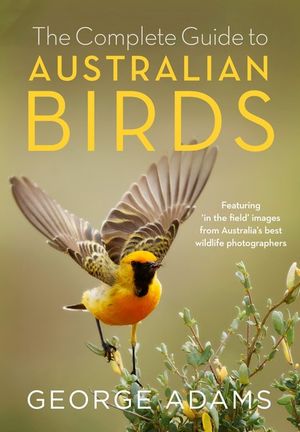 NEW: The Complete Guide to Australian Birds, by George Adams.
 This is another of the newer ones (published in November 2018) that I bought recently (June 2020). It's got photographs rather than drawn pictures of the birds. They're really good quality photos. 10 or more years ago, the Australian bird field guides with photographs definitely weren't in the same class as the ones with hand-drawn pictures, but that seems to have changed. Now I think it's more a matter of personal preference. I imagine that the massive increases in availability of long-zoom-distance digital photographic equipment has made it much easier for there to be better quality photos of birds.
This book has colured strips down the outside of each page so you can find the different types of birds easily, which I really like.
Purchase from Australia (The Nile)
Purchase from Australia (Fishpond)
Purchase from Amazon.com (USA Site)
Purchase from Amazon.com.au (Australian Site)
|
|
 NEW: Know Your Birds, by Louise Egerton.
 Revised edition 3 July 2019. Paperback / softback, 176 pages. It has an orange cover. The original edition was 2005 and has a blue cover. Some of the book sellers listed here show the photo from the original/older blue cover edition, but the rest of the info (including the publication date and ISBN) are from the newer revised 2019 edition, so presumably that's the one you'll get.
This book has very high quality large photographs of the birds (as in actual photographs). Most of the photos take up a whole page for each bird photograph. "Know Your Birds" only has a selection of the most common birds, and not all the birds that are found in Australia. This makes it very good for beginners — since most of the field guides have all the birds — and it can be confusing looking at six almost identical species of birds, not knowing that five of them are rare and it's probably the common one that you're looking for. Which would be the only one listed in this book.
Purchase from Australia (The Nile)
Purchase from Australia (Fishpond)
Purchase from Amazon.com.au (Australian Site)
|
I also have the Simpson and Day CD-ROM edition
of their field guide, version 5.0. Its okay, though it really bugs
me that you need to
have the CD inserted in your computer for it to work, even if you
copy the whole CD to your hard drive, which means its really slow.
I think they must have made this version before there were CD burners,
because they thought it would stop people copying it—as
I can't
see
any
other
reason why they would have made it this way. There are audio tracks
of the calls of almost all of the birds, which are of medium-grade
quality. I don't think its available anywhere anymore.
|
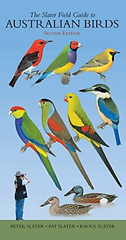
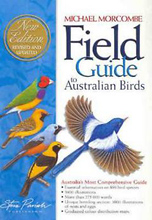 NEW: Field Guide to Australian Birds, by Michael Morcombe. This one has colour drawings of the eggs and the nests which not many other field guides do (I can't think of any that do). It's an excellent field guide and one of the four main ones (the other three being above this one). The weakness of this field guide is that some of the pictures of the birds aren't as good (or accurate) as the other three most used field guides. It's also the heaviest though there is a pocket edition which is much smaller and lighter.
Purchase or read reviews on Amazon.com.au
|
|
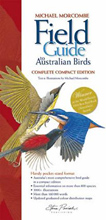 NEW: Field Guide to Australian Birds: Complete Compact Edition, by Michael Morcombe. Based on the above larger book. It's a while since I've seen this one. The publisher's commentary says that "This slimline, compact edition contains the same information on mainland and Tasmanian birds as his best-selling handbook, the Field Guide to Australian Birds. Features include plastic jacket, QuickFind system of colour tags and Quick Index ensure durability and ease of use in the field."
Purchase from Amazon Australia (May be out of stock)
|
|
 NEW: Finding Australian Birds A Field Guide to Birding Locations, by Tim Dolby and Rohan Clarke. From the eastern rainforests to central deserts, Australia is home to some 900 species of birds. This book covers over 400 Australian bird watching sites conveniently grouped into the best birding areas, from one end of the country to the other. This includes areas such as Kakadu in the Top End and rocky gorges in the central deserts of the Northern Territory, the Great Barrier Reef in Queensland, rainforests distributed along the eastern Australian seaboard, some of the world's tallest forests in Tasmania, the Flinders Ranges and deserts along the iconic Strzelecki and Birdsville Tracks in South Australia, and the Mallee temperate woodlands and spectacular coastlines in both Victoria and south west Western Australia.
Purchase from Amazon Australia May be hard to find or expensive
|
|
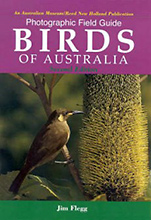 Photographic Field Guide Birds of Australia: Second Edition, Jim Flegg. This field guide to Australian birds is different to most in that it has photographs of each bird, rather than drawings or paintings. If you would prefer to see actual photographs of the birds, this is your guide. Most people prefer a field guide with drawings though, since the drawings are specially done to look like a generic representation of the bird, and also to point out details that can be used to tell one species from another very similar species. Photographs, especially of the more rare birds, do not always show the birds looking like they will when you see them in the wild. However, sometimes it is nice to see a real photo rather than a drawing.
Click here to purchase from Australia (The Nile) (May be unavailable) |
|
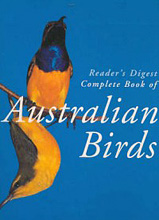 Reader's Digest Complete Book of Australian Birds. A
very very large blue hardcover book with a dust jacket that matches the cover. It is the tallest book I own, and it is so big that I have only one shelf that it fits on. You could work out by lifting it a few times.
Colour photos and detailed
descriptions of all the birds. Not a field guide as such (so not as good if you just want a book to learn to identify the birds). Not your usual coffee table book either because it lists every bird. Contains lots of information about every bird in Australia. Excellent.
Reader's Digest Complete Book of Australian Birds. A
very very large blue hardcover book with a dust jacket that matches the cover. It is the tallest book I own, and it is so big that I have only one shelf that it fits on. You could work out by lifting it a few times.
Colour photos and detailed
descriptions of all the birds. Not a field guide as such (so not as good if you just want a book to learn to identify the birds). Not your usual coffee table book either because it lists every bird. Contains lots of information about every bird in Australia. Excellent.
Purchase or read reviews on Amazon.com.au (New or secondhand, may be expensive)
Click here to search new and used in Australia (Fishpond) (Probably unavailable)
Click here to purchase from Australia (The Nile) (Probably unavailable)
Buy from Amazon
|
|
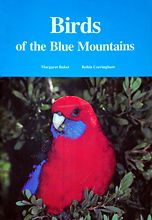 Birds of the Blue Mountains, Margaret Baker and Robin Corringham. This
was my first bird book, and a really good one to start with for the Blue Mountains
(and probably also, to a lesser extent, the greater Sydney area).
There is only a few birds in it (about 50), you can flick
through it and quickly find common birds when you are starting out. They are all native birds, there are no introduced (feral) birds like the Indian Myna or the Feral Pigeon. Birds of the Blue Mountains, Margaret Baker and Robin Corringham. This
was my first bird book, and a really good one to start with for the Blue Mountains
(and probably also, to a lesser extent, the greater Sydney area).
There is only a few birds in it (about 50), you can flick
through it and quickly find common birds when you are starting out. They are all native birds, there are no introduced (feral) birds like the Indian Myna or the Feral Pigeon.
Click here to look for secondhand on AbeBooks |
|
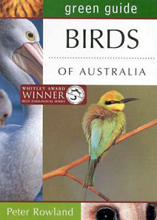 Common Birds of Australia (Green Guide), Peter Rowland. A smaller, more introductory book. It won a Whitley Award for best zoological book. The publishers say "This book provides an introduction to the major bird groups, with an emphasis on those that the amateur naturalist and nature-lover is most likely to see. The book is organized into six sections which cover birds of prey, waders and waterbirds, seabirds, songbirds, pigeons and parrots and other birds. Information is organized simply, with individual species or group entries describing key characteristics — where they are found, food requirements and behavioural habits. Each entry is accompanied by a colour photograph and, where appropriate, distribution maps. A key feature of the text is the "gee whiz" spreads which answer many of the most commonly asked questions about why birds do what they do, revealing facts and providing practical information for the amateur enthusiast. In addition, fact panels interspersed throughout highlight surprising snippets of information.
Click here to purchase from Australia (Fishpond)
Click here to purchase from Australia (The Nile) (May be unavailable) |
 Australian BirdKeeper Magazine is Australia's premier publisher of bird pet and aviary literature. Apart from the magazine itself they have a huge range of books on different types of birds. They also have DVDs, and fish, amphibian, and reptile material as well. Australian BirdKeeper Magazine is Australia's premier publisher of bird pet and aviary literature. Apart from the magazine itself they have a huge range of books on different types of birds. They also have DVDs, and fish, amphibian, and reptile material as well.
What Bird Call is That? Terence Lindsey. This is probably out of
print. It comes with an audio cassette with the bird calls on it.
Contains the most common birds in the Southeast of Australia.
|
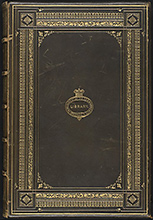 Birds of Australia, John Gould. Published in 1848, this is a classic set of seven huge leather-bound volumes containing high-quality plates of many of Australia's birds. In the Australian Birds section of my site I've used (with permission) many of the bird images from the digital collection of this book at the National Library of Australia. Many of the bird names (both common names and scientific names) have changed since then, so it can be confusing to match up the birds with the original names used by Gould. On this site I have shown Gould's plates along with the modern names for the birds. Birds of Australia, John Gould. Published in 1848, this is a classic set of seven huge leather-bound volumes containing high-quality plates of many of Australia's birds. In the Australian Birds section of my site I've used (with permission) many of the bird images from the digital collection of this book at the National Library of Australia. Many of the bird names (both common names and scientific names) have changed since then, so it can be confusing to match up the birds with the original names used by Gould. On this site I have shown Gould's plates along with the modern names for the birds.
|
|
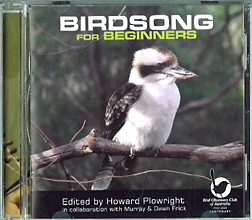 Birdsong For Beginners, Bird Observation and Conservation Australia (BOCA). I haven't heard this CD (nor do I get any commission for selling it or any of the BOCA stuff), I am including it to make this page a more complete collection of Australian field guides and naturalist resources.
Get it from BOCA (Doesn't seem to be available anymore)
|
|
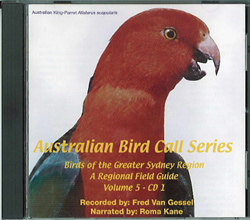 Australian Bird Call Series, Fred Van Gessel. There are a few different volumes, each one focusing on a different area of Australia. Volume 5 is the Greater Sydney Region. The Sydney ones (at least) are the standard by which all the others are judged, which are recommended by birdwatching clubs.
Bird Calls of the Greater Sydney Region (Doesn't seem to be available anymore)
Other sets of Australian bird calls (Doesn't seem to be available anymore) |
|
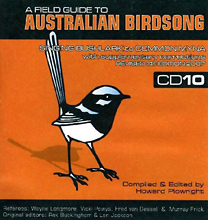 A Field Guide to Australian Birdsong, Bird Observation and Conservation Australia (BOCA). A comprehensive 10-CD set that covers the bird calls from all around Australia. Each CD may be purshased separately or as a set of all 10.
Click here to purchase from BOCA Australia (Doesn't seem to be available anymore) |
|
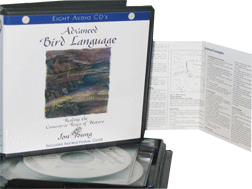 Advanced Bird Language, Jon Young. Advanced Bird Language is an 8-CD audio set which teaches you how to interpret bird language, and other aspects of naturalist awareness. Note that these are not recordings of actual bird calls used to learn to identify which bird sounds like which call — rather they are a series of talks where Jon teaches you how to learn, by observing the birds yourself, what the birds are saying by their calls, their body language, and their other behaviours. The teachings are from North America but they apply to any country.
Purchase or read reviews on Amazon.com.au (Probably second hand, may be expensive, may be CD or cassette depending on what's available at any given time)
Click here to purchase from Wilderness Awareness School (You have to email them for orders outside the USA) |
|
 Sydney Birds and Where to Find Them, Peter Roberts. The 30 top bird-watching localities in and around Sydney. These birding hot spots stretch from Tuggerah Lakes on the Central Coast to Lake Illawarra near Wollongong and from the Blue Mountains in the west to some surprisingly accessible sites tucked away in the heart of the city. Each locality entry lists the key species to look out for including rare and seasonal visitors. It describes how to access the location, and what amenities to expect; maps are featured. There is also a handy list of Sydney birds, each entry providing information on the best spots to find it.
Click here to purchase from Australia (The Nile)
Click here to purchase from Australia (Fishpond) Probably more expensive |
|
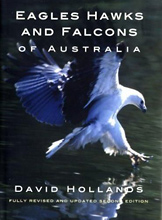 Eagles, Hawks and Falcons of Australia David Hollands. A blend of writing and photography with an essay on each of the 24 species of eagles, hawks and falcons in Australia.
Click here to purchase from Australia (The Nile) (May be unavailable) |
|
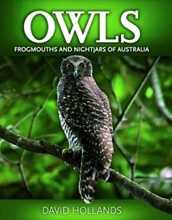 Owls, Frogmouths and Nightjars of Australia, David Hollands. A comprehensive look at all seventeen Owls, Nightjars and Frogmouths of Australia. Richly illustrated with over 200 photographs, showing all aspects of the birds' lives.
Click here to purchase from Australia (The Nile) |
|
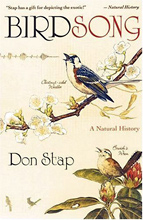 Birdsong, Don Stap. From the promotional material: "Following one of the world's experts on birdsong from the woods of Martha's Vineyard to the tropical forests of Central America, Don Stap brings to life the quest to unravel an ancient mystery: Why do birds sing and what do their songs mean? We quickly discover that one question leads to another. Why does the chestnut-sided warbler sing one song before dawn and another after sunrise? Why does the brown thrasher have a repertoire of two thousand songs when the chipping sparrow has only one? And how is the hermit thrush able to sing a duet with itself, producing two sounds simultaneously to create its beautiful, flutelike melody?"
Click here to purchase from Amazon Australia
Click here to purchase from Australia (Fishpond)
Click here to purchase from Wilderness Awareness School $24.00 USD (May not work) |
Reptiles and Amphibians
|
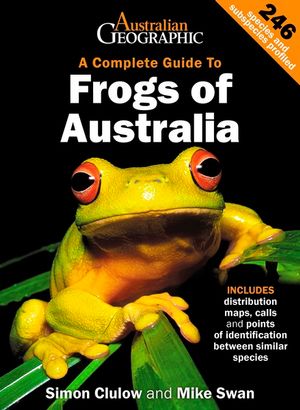 NEW: A Complete Guide To Frogs of Australia, by Simon Clulow and Mike Swan.
 I bought this one recently (in July 2020) and it is great. It has photographs of the frogs, rather than line drawings. It covers all 246 currently recognised species and subspecies of Australian Frogs. First published in 2018.
It has descriptions (in words) of what the call of each frog sounds like, which are quite good considering how hard it is to describe a frog call in written words. The cover has a clear plastic sheath around it which is quite strong, and doesn't have much of a vinyl chloride smell.
It's the best frog field guide that I've seen yet. Very highly recommended!
Purchase from Australia (Fishpond)
Purchase from Amazon.com (USA Site)
|
|
 Reptiles and Amphibians of Australia, by Harold G. Cogger. This edition is from 2014. It's expensive and has 1056 pages.
The publisher says "Reptiles and Amphibians of Australia is a complete guide to Australia’s rich and varied herpetofauna, including frogs, crocodiles, turtles, tortoises, lizards and snakes. For each of the 1194 species there is a description of its appearance, distribution and habits. Each species is accompanied by a distribution map and, in most cases, a colour photograph of the living animal. The book includes 130 simple-to-use dichotomous keys that in most cases allow a specimen in hand to be identified."
Purchase from Australia (Amazon.com.au)
|
|
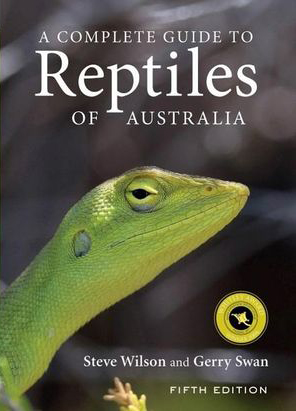 NEW: A Complete Guide to Reptiles of Australia, Steve Wilson and Gerry Swan, Fifth Edition. This book has photos of all the reptiles in Australia. (I think its all of them, its a lot anyway, over 1000 species.) This is my new favourite reptile field guide. It's got actual photos rather than artistically rendered drawings. The 5th edition came out in 2017.
Purchase from Amazon Australia |
|
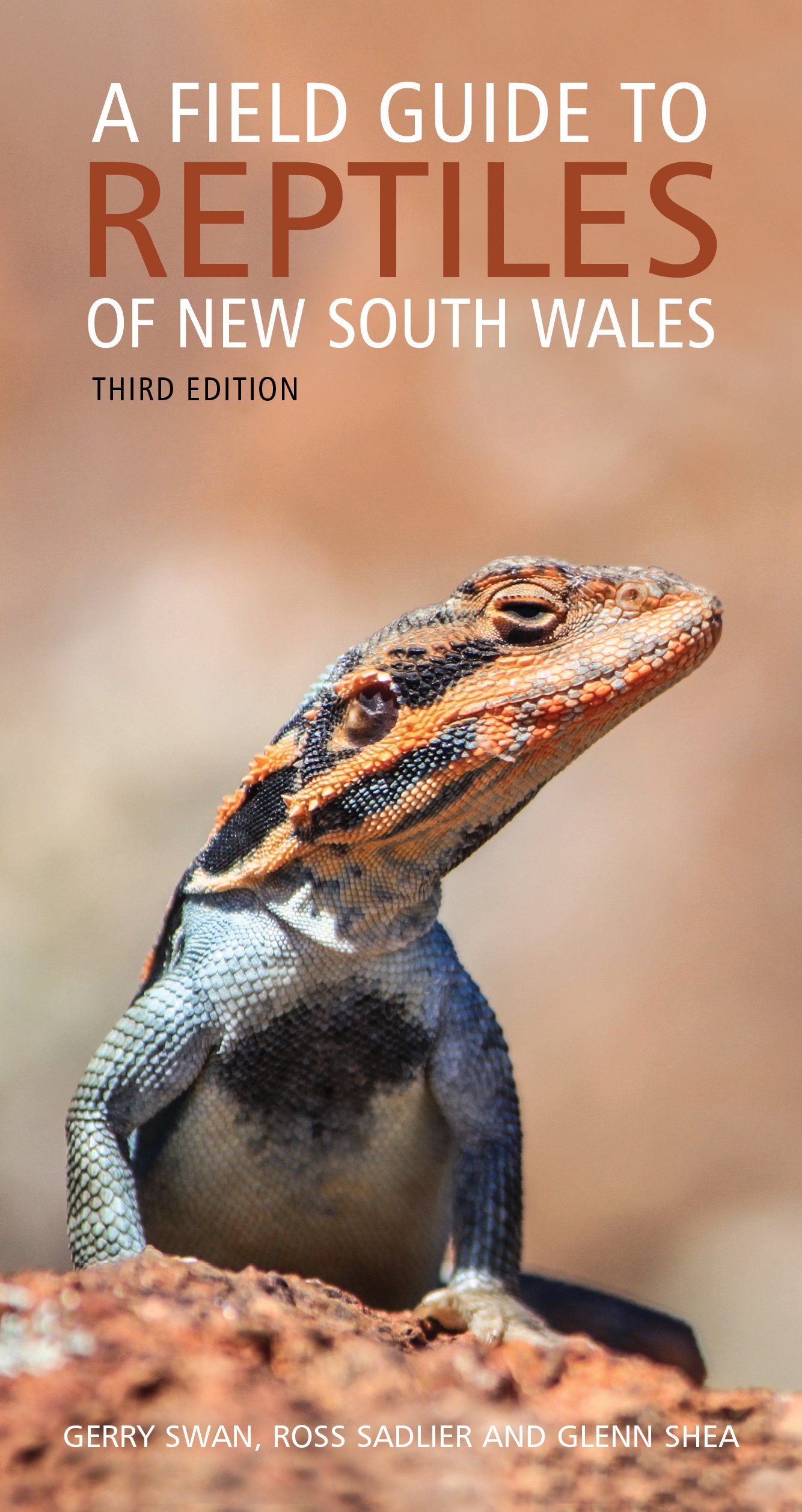 A Field Guide to Reptiles of New South Wales, Ross Sadlier, Gerry Swan and Glenn Shea. I've flicked through this book several times in shops and almost bought it. From what I remember it is similar to the Complete Guide to Reptiles of Australia (shown above), but it only covers NSW so it is smaller and cheaper. It covers all the reptile species in NSW, including freshwater and marine turtles.
Click here to purchase from Australia (Amazon.com.au) |
Australian Frog Calls, Subtropical East, David Stewart (an
audio CD). Quite good quality recordings of the calls of 74 species of
frogs. You might be able to still buy it from here.
Fishes
There's definitely a shortage of good all-round Australian field guides to fishes. There were a few others a few years ago, covering all of Australia, that don't seem to be easily available anymore. There are still currently available fish guides written for sports fishing as the target audicnce, and and also a few about tropical fishes.
Some of the tropical field guides to fishes do show fish from the southern waters of Australia though, so it's not as bad as it seems. There seems to be more species of tropical fish, and they look more colurful and interesting in general, so perhaps that's why there are more books about them. Also much of the beach/ocean tourist market (other than sport fishing), including snorkeling and scuba diving, is probably in the less deep-southerly (and cold) waters of Australia. A good fish field guide that covers all of Australia (Swainston's one) is meant to be back in print in late September 2020.
|
 A Photographic Guide to Sea Fishes of Australia, Rudie H. Kuiter.
This is perhaps the best Australian fish field guide that covers all of Australia (including fish that only live in the south), that's still available currently (July 2020). It's only small physically, though that can be good for field guides if you want to take them out in the field with you. It covers all of Australia, including species that only live in the southern waters of Australia. A Photographic Guide to Sea Fishes of Australia, Rudie H. Kuiter.
This is perhaps the best Australian fish field guide that covers all of Australia (including fish that only live in the south), that's still available currently (July 2020). It's only small physically, though that can be good for field guides if you want to take them out in the field with you. It covers all of Australia, including species that only live in the southern waters of Australia.
The pictures are high-quality and as physically large on the pages as some of the larger field guides, though the text is smaller in this one. There is a decent amount of text though, including information about most of the fishes' habitats, and for some of the species there's information about their lives, and habits — and not just descriptions of how to identify them. There are less species overall than the larger field guides, though once you know 222 Australian fish species you'll know a lot about fish identification.
Like the title says, it only covers sea fishes, and not inland/freshwater fishes.
From the publisher: "A guide for the diver, traveller, fishing enthusiast, or layperson, which aims to provide easy identification of the 222 species of fish covered. Photographs and distribution maps accompany each description, and some show juvenile and adult, or sex variations."
Click here to purchase from Australia (The Nile) (In stock as of 8 July 2020)
Click here to purchase from Australia (Fishpond) (In stock as of 8 July 2020) |
|
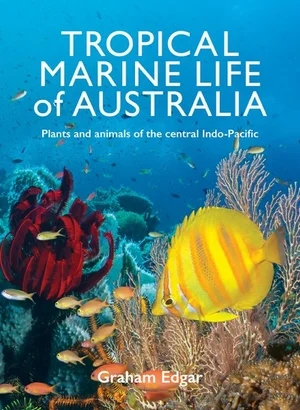 NEW: Tropical Marine Life of Australia: Plants and Animals of Tropical Waters, by Graham Edgar.
 This is a truly beautiful field guide to Australian fishes and other marine life. It's a newer one, first published in August 2019. It contains not only fish, but many other types of life, such as shellfish and other molluscs, and even species of ocean plants (e.g. "seaweed") and fungi — over 2400 species in total are shown in its 600 pages. There's information in the printed text about the species beyond just identification details. It does have some species that live in the southern waters of Australia, as long as the species doesn't only occur in the south.
It's the best sea life field guide that I have so far, I really love this one. Unfortunaely it can be hard to find now (2024) though.
Purchase from Australia (The Nile)
Purchase from Australia (Fishpond)
Search for this book on Google Search
|
|
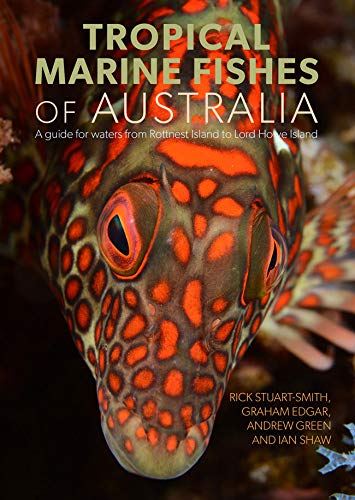 NEW: Tropical Marine Fishes of Australia, by Rick Stuart-Smith, Graham Edgar, Andrew Green and Ian Shaw.
 This is a really lovely field guide. It's got a clear plastic detachable covering, which doesn't have a strong vinyl chloride smell. Despite the title of "tropical", it does have some species from southern waters, as long as part of that species' range extends about as far north as Lord Howe Island in the East, or the Abrolhos islands in the West of Australia. It covers almost 1100 species, "often with multiple images for important life stages". Some of the photographs are bigger on the page than others, but they are high quality.
There's not a huge amount of text written about each species, and nearly all of what is written is about identification of the fish, rather than their habits or other information about the life of the fish.
Purchase from Amazon.com.au (Australian Site)
|
|
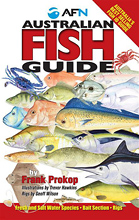 AFN Australian Fish Guide,
by Frank Prokop. Most or all the fish books I had listed originally are unavailable now. The publisher says about this one, AFN Australian Fish Guide,
by Frank Prokop. Most or all the fish books I had listed originally are unavailable now. The publisher says about this one,
"This book is an invaluable reference for any angler, freshwater or saltwater, wanting to identify their catch. It contains detailed descriptions and accurate illustrations of each fish, as well as diagrams of the best rigs to catch them.
Easy to follow colour coded sections include: freshwater sportfish, freshwater and saltwater baitfish, estuary/surf species, reef species, marlin, tuna, shark and ray species, freshwater and saltwater baits, and the new invertebrates section.
Whatever fish you're chasing you'll find all the information you need to catch it and identify it in this comprehensive book. "
Purchase from Amazon Australia |
|
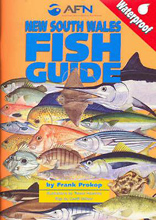 AFN New South Wales Fish Guide: Waterproof Pocket Size,
by Frank Prokop. Pocket sized waterproof fish guide that covers all the popular freshwater and saltwater fish in New South Wales. Over 70 of Australia's most popular sport fish are included in this convenient, easy to use waterproof guide.
Purchase from Amazon Australia AFN New South Wales Fish Guide: Waterproof Pocket Size,
by Frank Prokop. Pocket sized waterproof fish guide that covers all the popular freshwater and saltwater fish in New South Wales. Over 70 of Australia's most popular sport fish are included in this convenient, easy to use waterproof guide.
Purchase from Amazon Australia
|
|
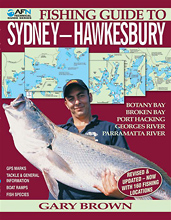 AFN Fishing Guide to Sydney-Hawkesbury: Revised & Update - Now with 160 Fishing Locations,
by Gary Brown. Find out where and when to fish in and around Sydney's waterways. Both freshwater and saltwater locations are covered including Port Hacking, Botany Bay, Sydney Harbour, Broken Bay, coastal and offshore spots as well as the Hawkesbury, Parramatta and Georges river systems. Inside are many essential details for anglers including fish species, boat ramps, tackle shops, bait and emergency services. AFN Fishing Guide to Sydney-Hawkesbury: Revised & Update - Now with 160 Fishing Locations,
by Gary Brown. Find out where and when to fish in and around Sydney's waterways. Both freshwater and saltwater locations are covered including Port Hacking, Botany Bay, Sydney Harbour, Broken Bay, coastal and offshore spots as well as the Hawkesbury, Parramatta and Georges river systems. Inside are many essential details for anglers including fish species, boat ramps, tackle shops, bait and emergency services.
The expert tips in the text combined with the detailed maps of specific fishing areas will enable all to enjoy the experience of 'dropping a line' - whether it be from the beach, the rocks, the banks of the estuaries, a canoe, a tinny or from the best equipped fishing boat available. Using Fishing Guide to Sydney-Hawkesbury anglers will be able to achieve positive results time and time again.
Click here to see AFN Fishing Guides for other Australian locations (Amazon Australia) |
|
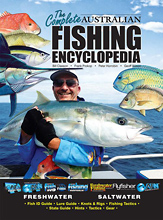 The Complete Australian Fishing Encyclopedia: AFN Technical,
by Bill Classon, Frank Prokop, Peter Horrobin and Geoff Wilson. The publisher's info says "This is the most comprehensive book on Australian fishing yet produced. The experts at the Australian Fishing Network, Freshwater Fishing Magazine and Sport Fishing Australia Magazine have created the ultimate fishing reference book Australian Fishing Encyclopedia." The Complete Australian Fishing Encyclopedia: AFN Technical,
by Bill Classon, Frank Prokop, Peter Horrobin and Geoff Wilson. The publisher's info says "This is the most comprehensive book on Australian fishing yet produced. The experts at the Australian Fishing Network, Freshwater Fishing Magazine and Sport Fishing Australia Magazine have created the ultimate fishing reference book Australian Fishing Encyclopedia."
It is quite good. It includes a 52-page field guide to the most common species, fresh and salt water.
The field guide is fishing-oriented and includes information on what rigs to use and how to fish for them.
Lots of excellent colour pictures.
This book is now hard to find, I'll add other currently available books soon. Click here to view some on Amazon Australia |
|
 Field Guide to Marine Fishes of Tropical Australia and South-East Asia,
by Gerald R. Allen. Most or all the fish books I had listed originally are unavailable now. The publisher says about this one, "This phenomenally successful guide to the wealth and variety of fish in Australia's tropical waters - including the Great Barrier Reef - and south-east Asia has been updated and expanded. The book has sold more than 20,000 copies in its previous editions, and is an invaluable reference for divers and anglers, to both scientists and the lay person; to everyone with an interest in our remarkable tropical fish. Full colour illustrations by leading Australian marine artists, Roger Swainton and Jill Ruse, make identification easy. The author has also included an edibility guide." Field Guide to Marine Fishes of Tropical Australia and South-East Asia,
by Gerald R. Allen. Most or all the fish books I had listed originally are unavailable now. The publisher says about this one, "This phenomenally successful guide to the wealth and variety of fish in Australia's tropical waters - including the Great Barrier Reef - and south-east Asia has been updated and expanded. The book has sold more than 20,000 copies in its previous editions, and is an invaluable reference for divers and anglers, to both scientists and the lay person; to everyone with an interest in our remarkable tropical fish. Full colour illustrations by leading Australian marine artists, Roger Swainton and Jill Ruse, make identification easy. The author has also included an edibility guide."
Purchase from Amazon Australia
|
|
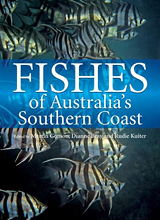 Fishes of Australia's Southern Coast,
edited by Martin Gomon, Dianne Bray and Rudie Kuiter. Fishes of Australia's Southern Coast,
edited by Martin Gomon, Dianne Bray and Rudie Kuiter.
Brings together the latest scientific knowledge on more than 860 species inhabiting Australia's temperate southern waters, from the Recherche Archipelago at the western end of the Great Australian Bight to Wilson's Promontory in the east, many found nowhere else.
I really wish I had bought a copy of this one when they were still available.
Purchase or read reviews on Amazon.com.au (Probably unavailable)
|
|
 A Field Guide to Fish of Australia, Pocket File Series,
Penguin Books. A small fold-out field guide (not a book as such) of the most
common freshwater and saltwater fish. Colour photos and descriptions.
It's not very large, it folds out to the size of about two A4 pages
stuck together end to end. A Field Guide to Fish of Australia, Pocket File Series,
Penguin Books. A small fold-out field guide (not a book as such) of the most
common freshwater and saltwater fish. Colour photos and descriptions.
It's not very large, it folds out to the size of about two A4 pages
stuck together end to end.
Click here to purchase from Australia (The Nile) (May be unavailable) |
|
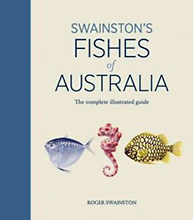 Swainston’s Fishes of Australia, Roger Swainston. A new fish book (October 2010). The publishers say Roger Swainston's breathtaking artwork provides a fascinating overview of the extraordinary diversity of Australia's marine and freshwater fishes. Here, more than 1500 remarkable illustrations portray every family of fishes ever recorded from Australian waters. The names of all known species are listed alongside detailed information on the taxonomy and biology of each family.." Swainston’s Fishes of Australia, Roger Swainston. A new fish book (October 2010). The publishers say Roger Swainston's breathtaking artwork provides a fascinating overview of the extraordinary diversity of Australia's marine and freshwater fishes. Here, more than 1500 remarkable illustrations portray every family of fishes ever recorded from Australian waters. The names of all known species are listed alongside detailed information on the taxonomy and biology of each family.."
Note from 1 July 2020: It appears to have gone out of print and will be re-released on 29 September 2020.
Click here to purchase from Australia (Amazon.com.au) (The Amazon page as of 1 July 2020 says you can preorder, and it's released on 29 September 2020) |
|
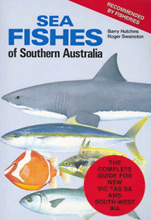 Sea Fishes of Southern Australia, Barry Hutchins. A complete guide for NSW, Victoria, Tasmania, South Australia, and southwest Western Australia, covering more than 700 species, with 1000 colour illustrations; also gives information on dangerous fishes and first aid; fish deformities and parasites; edibility, fish preservation and photography; Australian record sizes. Sea Fishes of Southern Australia, Barry Hutchins. A complete guide for NSW, Victoria, Tasmania, South Australia, and southwest Western Australia, covering more than 700 species, with 1000 colour illustrations; also gives information on dangerous fishes and first aid; fish deformities and parasites; edibility, fish preservation and photography; Australian record sizes.
Click here to purchase from Australia (The Nile) (Can't find anywhere that still has it currently, sorry.) |
|
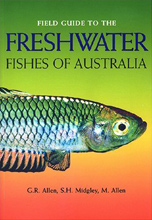 Field Guide to Freshwater Fishes of Australia G.R. Allen, S.H. Midgely and M. Allen. A really nice fish book. The publishers say "From tiny gobies to the giant barramundi, this volume provides in-depth coverage of nearly 300 species - every fish known to inhabit fresh water on the Australian continent. Each species is illustrated with additional hints for rapid identification and a concise summary of biological knowledge." Field Guide to Freshwater Fishes of Australia G.R. Allen, S.H. Midgely and M. Allen. A really nice fish book. The publishers say "From tiny gobies to the giant barramundi, this volume provides in-depth coverage of nearly 300 species - every fish known to inhabit fresh water on the Australian continent. Each species is illustrated with additional hints for rapid identification and a concise summary of biological knowledge."
Click here to purchase from Australia (The Nile) (May be unavailable) |
|
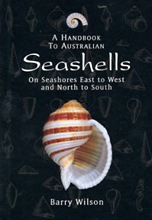 A Handbook to Australian Seashells, Barry Wilson. This is a lovely guide to seashells. Seashells are actually invertebrates, though it seems like they should go in the fishes section.
The product info goes like this "A Handbook to Australian Seashells will help you to identify most of the shells you find, no matter where you are on the Australian coast. It includes over 375 species of the most common seashells found along our seashores. Each one is illustrated with a beautiful colour photograph showing its colours, patterns, shape and sculpture."
Click here to purchase from Australia (The Nile) (May be unavailable) |
Click here to see more Australian fish field guides from "The Nile" bookshop.
Invertebrates
|
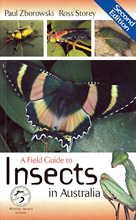 A Field Guide to Insects in Australia, Paul Zborowski and
Ross Storey. New Holland Publishers, 1995-2003. To be
honest I haven't used this book very much. Often I see things in
the garden and look in the
book, and don't find them there. It's a good book though, more of a scientific book (though it has lots of colour pictures). Since there
are "more than 86,000 species of
insects
described
in
Australia",
I guess
it
is
hard to find a book that has more than a tiny fraction of them in
it. This book goes through the orders and suborders and families,
rather than listing a representative sample of the species. The book
is only about insects —
that is, no spiders or ticks or centipedes, etc.
A Field Guide to Insects in Australia, Paul Zborowski and
Ross Storey. New Holland Publishers, 1995-2003. To be
honest I haven't used this book very much. Often I see things in
the garden and look in the
book, and don't find them there. It's a good book though, more of a scientific book (though it has lots of colour pictures). Since there
are "more than 86,000 species of
insects
described
in
Australia",
I guess
it
is
hard to find a book that has more than a tiny fraction of them in
it. This book goes through the orders and suborders and families,
rather than listing a representative sample of the species. The book
is only about insects —
that is, no spiders or ticks or centipedes, etc.
Click here to purchase from Australia (The Nile) (Probably unavailable) |
|
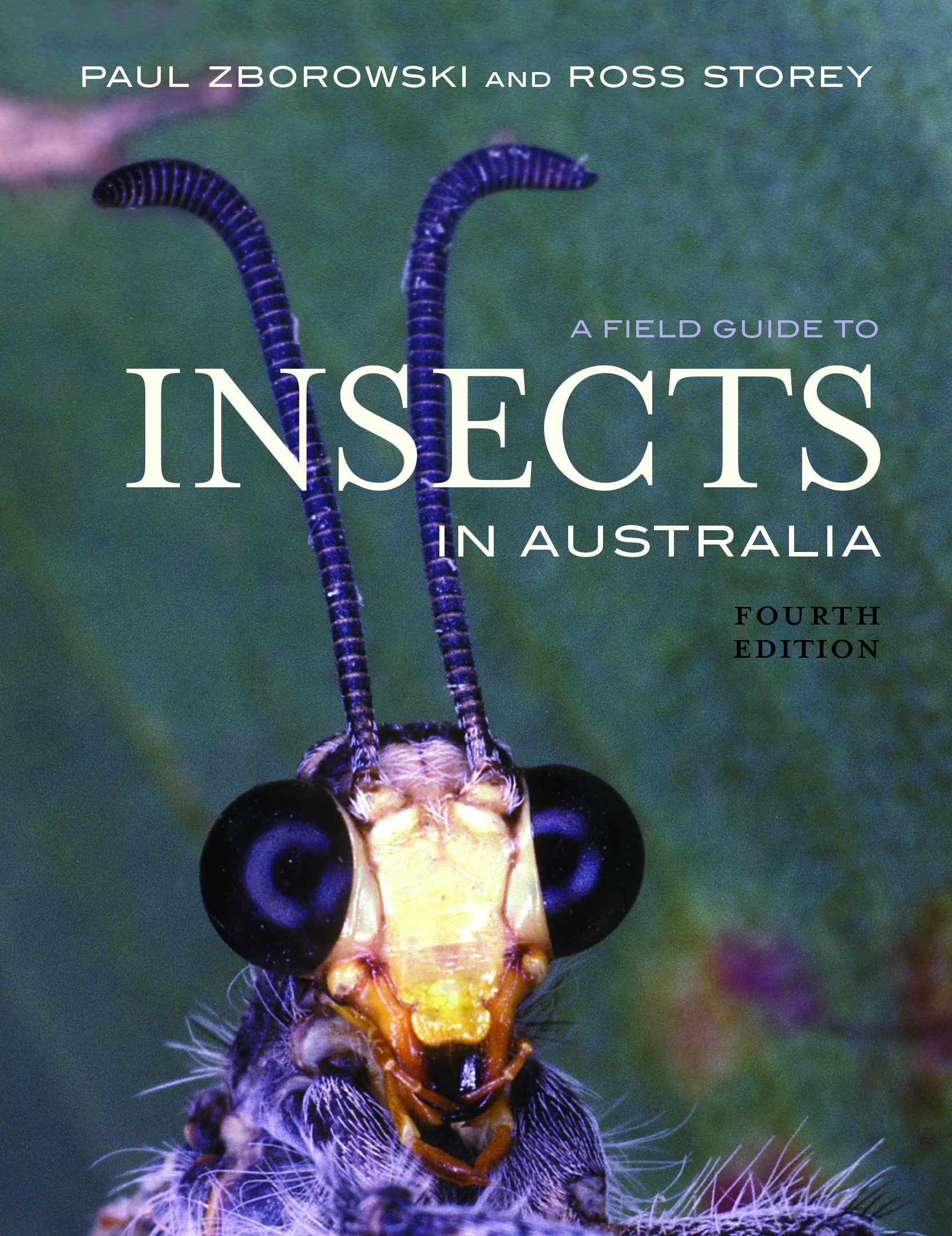 NEW: A Field Guide To Insects In Australia, by Paul Zborowski and Ross Storey.
 Now it's up to the Fourth Edition. I like this book much more than I did originally. I bought an earlier edition which I later gave away, then later I got the 3rd one. The only thing "wrong" with it is that it lists the insect families, rather than saying much on individual species like most other field guides do. This is no doubt because there are so many insect species, about 60,000 named species, plus another 20,000 waiting to be named, and a huge number more undiscovered species. And that's just in Australia. It's only about insects, not other invertebrates like spiders. It's got a proper index, and (maybe the fourth edition also has) a clear plastic cover over the ordinary soft cover. From the publisher, "This Fourth Edition has more than 300 colour photographs that show the insects in their natural habitat, and the line drawings clearly illustrate subtle differences where identification is tricky.
Whether you're an amateur insect enthusiast, a student or an entomologist, this updated and revised fourth edition of A Field Guide to Insects in Australia will help you to identify insects from all the major insect groups. With more photographs and up-to-date information, it will enable you to differentiate between a dragonfly and a damselfly or a cricket and a grasshopper. You'll find cockroaches, termites, praying mantids, beetles, cicadas, moths, butterflies, ants and bees. "
Purchase from Amazon.com.au (Australian Site)
|
|
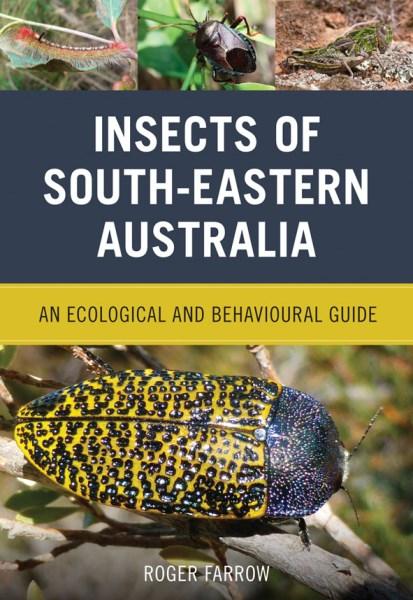 NEW: Insects of South-Eastern Australia: An Ecological and Behavioural Guide , by Roger Farrow.
 This newer insect guide (published in May 2016) one is more like a traditional field guide than the book by Zborowski. It lists the species and has more photos and more species, though less information per family. The photos are smaller and more scientific looking (meaning less beautiful looking). It's got a proper index (one for common names and one for scientific names). Because there are so many insect species it's impossible to cover everything in one book. From the publisher, "Insects of South-Eastern Australia is a unique field guide that uses host plants and behavioural attributes as the starting point for identifying insects. Richly illustrated with colour photographs, the different species of insects found in Australia's temperate south-east, including plant feeders, predators, parasites and decomposers, are presented.
The guide is complemented by an introduction to the insects of the region, including their environment, classification, life history, feeding strategies and behaviour. Fascinating boxes on camouflage, mimicry and many other topics are also included throughout. "
Purchase from Amazon.com.au (Australian Site)
|
|
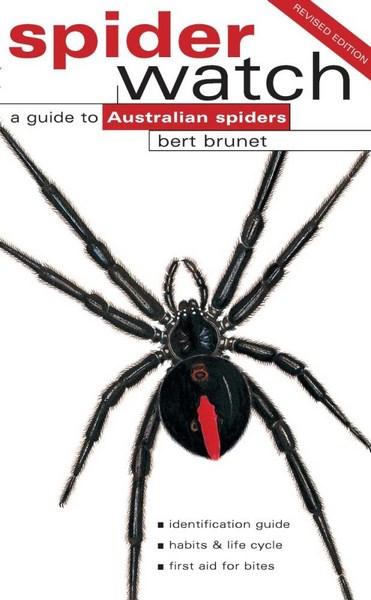 Spiderwatch: A Guide to Australian Spiders, by Bert Brunet.
 This was originally the best Australian spider book I'd seen, I first saw it at Featherdale where they sell it. Eventually I bought one from the Australian Museum bookshop. I've got three new spider field guides which I'll write up soon (August 2017).
From the publisher, "Illustrated with an identification guide, colour drawings and photographs, Spiderwatch is an easy-to-use and practical field manual. It contains advice on where to find spiders and how to draw, photograph and take notes on them as well as on anatomy and evolution. More than 100 of the most frequently encountered Australian spiders are depicted. Most of these are described in detail, with information on toxicity, habitat and prey capture. As well, Spiderwatch includes facts on Australia's dangerous spiders and advice on first aid."
Purchase from Australia (The Nile)
Purchase from Amazon.com.au (Australian Site)
|
|
 NEW: A Field Guide to Spiders of Australia, by Robert Whyte and Greg Anderson.
 This is my favourite field guide to Australian spiders. It has a proper index. It has amazing photographs. If I had to find a weak point of it, it would be that there are so many photos that there is less writing than there could have been. I like photos though so it's all good. 464 pages. From the publisher, "A Field Guide to Spiders of Australia uses photographs of live animals to enable identification of commonly encountered spiders to the family level and, in some cases, to genus and species. Featuring over 1300 colour photographs, it is the most comprehensive account of Australian spiders ever published. With more than two-thirds of Australian spiders yet to be scientifically described, this book sets the scene for future explorations of our extraordinary Australian fauna."
Purchase from Amazon.com.au (Australian Site)
|
|
 NEW: A Guide to the Spiders of Australia, by Volker W. Framenau, Barbara C. Baehr, and Paul Zborowski.
 This is a great field guide to Australian spiders. It's a toss up between this one and Spiderwatch for my second favourite spider field guide. This one is a lot different to Spiderwatch. It's got more than twice the number of pages. It's got much better photos. It comes with a soft clear plastic cover protecting the usual soft cover. On the other side of the argument, it's got no index other than an index of family names (i.e. no index of actual spider names, not their common names and not their scientific names). Which makes it hard to find things in it, if you don't know what family they are in. Also it's based on families and not individual spider species. It's still a wonderful book though. From the publisher, "This definitive guide to the subject, written by three experts in the field, offers a window into a fascinating world. Notorious species such as the Redback and the Sydney Funnel-web sit alongside less wellknown but equally intriguing spiders such as the ant-mimics and net-casting spiders. The introduction covers spider structure, evolution, reproduction, silk and venom, together with peculiarities of the family within an Australian context.
The two main sections of the book deal with Trapdoor Spiders and Modern Spiders, and within each section there is a chapter on each of the 80 or so spider families that occur in Australia. Each is illustrated with beautiful photographs of the subjects, with more than 30 images per family for some of the larger groups such as the jumping spiders, and many rare images never before published. "
Purchase from Amazon.com.au (Australian Site)
|
|
 Spiders: A Wild Australia Guide, by Patrick Honan.
 96 pages. This is a smaller spider guide showing the most well known spiders and then a few more. From the publisher, "Australia is home to more than 2000 known species of spiders - and it is estimated that four times that number actually exist in this country waiting to be discovered! Within the ranks of Australian spiders we find some of the most uniquely interesting and skilled creatures of the animal world, along with a few potentially-deadly species and even more harmless individuals with fearsome reputations. Love them or loathe them, spiders are a part of everyday life, and this Steve Parish WILD AUSTRALIA GUIDE provides an insight into the lives of some of these often-reclusive visitors to our gardens, homes and wild places. From how to identify them and where they live, to their unique skills and behaviours, this guide lets you get up close to some of the most common Australian spiders. Who knows? You may even find some of these fascinating creatures living right under your nose."
|
|
 NEW: Spiders of Australia: Australian Green Guides, by Terence Lindsey.
 This is a smaller one at 96 pages. From the publisher, "The Australian Green Guides have been created for wildlife enthusiasts of all ages. The most commonly asked questions are answered with particular emphasis on fascinating behavioural insights into both common and unusual creatures.
The pages are alive with entertaining and informative text accompanied by exciting action photography."
Purchase from Amazon.com.au (Australian Site)
|
|
 Australian Spiders and Insects, Niki Horin. This is a new book (2010) that I haven't seen yet — I added it because I don't have many insect books (and no spider books) on this page yet. It doesn't cost much or have many pages (80). The advertising for it goes "Accessible, informative and entertaining, this spotter's guide to Australian insects and spiders is the perfect family reference, bushwalker's field guide and gardener's companion. It includes 130 colour photos, identification support and a first aid section."
There is another spider field guide that is really good, I have seen in shops, with a white cover and a black and red spider on the cover. Unfortunately I can't remember what it is called, though. (Its "Spiderwatch", shown above!)
Click here to purchase from Australia (The Nile) (Probably unavailable now) |
|
 NEW: Australian Insects: A Natural History, by Bert Brunet. 2010. I haven't seen it yet.
"This new edition of Australian Insects, with updated scientific names, records the physical attributes and lifestyle developments that have made life on this continent possible for insects. Insects are survivors. Since their evolution some 365 million years ago, they have penetrated almost every habitat on Earth. Today in Australia there are over 100,000 species crawling, flying, hopping and hurrying across the continent."
Click here to purchase from Amazon Australia |
Survival Books
My Top Two Survival Books
Survival DVDs
Permaculture, Self Sufficiency And Sustainable Living Books
Dystopian Fiction / Novels
Books About Near-Death Experiences
Return to Resources
Return to Site Map
3rd aboriginal above amazon animals anymore au australia australian author beautiful before bird birds black blue book books bought bush bushcraft call calls central colour common complete comprehensive contains cover covers cronin currently david description descriptions detailed distribution does drawings east ed edible excellent expensive family features field fish fishes fishing fishpond food free freshwater frogs fungi garden great guide guides hand handbook haven high identification identify illustrated illustrations includes including index indigenous information insect insects john july key knight known large larger life likely line listed live living looking lots mammals maps marine medicinal mostly mountains names native nature nile north note ones online original originally outback page pages people peter photographs photos pictures plant plants pocket poisonous print provides published publisher publishers quality rather read reading region regions reptiles reviews says scientific secondhand seen series site smaller south southern species spider spiders stock survival survive sydney text traditional trees tropical tucker unavailable updated usa version view volume waters website weeds west western why wild wilderness within work world written years yet
Content is copyright © Survival.org.au 2005-2026 All Rights Reserved. Terms of Use. Definitely read the disclaimer before trying anything from this website, especially including the practices and skills. This website uses affiliate links – this doesn't cost you any more, but I get a commission on purchases made through the website. As an Amazon Associate I earn similarly from qualifying purchases.
|