Survival Books
See Also: Survival DVDs, My Top Two Survival Books, Australian Field Guides and Nature Books, Instant Bookshelf to Survive The Apocalypse NEW, Books by Tom Brown, Jr., Permaculture, Self Sufficiency And Sustainable Living Books, Dystopian Fiction / Novels, Books About Near-Death Experiences, and Survival Courses Near Sydney and the Blue Mountains.
Many of the book links on this page currently go to Amazon (which is good for outside Australia). If you want to order any of the books from Australia (which is recommended if you live in Australia or New Zealand), I am gradually adding more links to Australian sources of the books. Also there are Australian links to some of the books on the other two book pages shown above.
Categories Found On This Survival Books Page
Featured Survival Books
Wilderness Survival Books
Wilderness Living Books
Books for Survival in the Future Hard Times
Other Survival Books
Featured Survival Books
|
 NEW: The Art of Resilience: Strategies for an Unbreakable Mind and Body, by Ross Edgley.
 This is a truly amazing book, which tells the story of the first person to swim all the way around Great Britain. It also gives a huge amount of background information on how to train your body to be strong and fit (that's an understatement). He gives many examples of people and of entire cultures (such as the traditional culture of Kenya) who learned to develop "The Art of Resilience".
It's more of a biographical/story styled book than a how-to manual as such, but it contains a massive amount of how-to information. I learned a heap (especially in terms of motivation, and some survival-related facts also) just from flicking through it for ten minutes in the bookshop. I'll write more about it when I've read more of it. First published May 2020 in hardcover, and June 2020 in softcover.
From the publishers:
Bestselling author and award-winning adventurer Ross Edgley has been studying the art of resilience for years, applying all he has learned to become the first person in history to swim around Great Britain, breaking multiple world records. Now Ross focuses on mental strength, stoicism and the training needed to create an unbreakable body.
Ross Edgley famously ran a marathon pulling a 1.4-tonne car and climbed a rope the height of Everest (8,848m), after living with Yamabushi warrior monks in Japan and partaking in Shamanic pain rituals with fire ants in the Amazon jungle. On his epic 1,780-mile journey around Great Britain, which lasted 157 days, Ross swam through giant jellyfish, arctic storms, ‘haunted' whirlpools and polluted shipping lanes, going so hard, and so fast, his tongue fell apart.
Ross's previous book, The World's Fittest Book, was a Sunday Times No.1 bestseller and explored the science of physical fitness. Now, in The Art of Resilience, Ross uses his swim experience and other amazing endurance feats, where he managed to overcome seemingly insurmountable pain, hardship and adversity, to study the performance of extreme athletes, military and fitness specialists and psychologists to uncover the secrets of mental fitness and explore the concept of resilience, persistence, valour and a disciplined mindset in overcoming adversity.
This ground-breaking book represents a paradigm shift in what we thought the human body and mind were capable of and will give you a blueprint to become a tougher, more resilient and ultimately better human — whatever the challenge you face.
Purchase from Amazon.com.au (Australian Site)
|
|
 The Art of Resilience had almost a whole shelf to itself when I bought it in Sydney — plus another small shelf around the corner from this one, plus another spot elsewhere in the shop. |
Wilderness Survival Books
|
 NEW: The Bushcraft Boxed Set, by Dave Canterbury and Jason A Hunt.
 This boxed set contains four great books by Dave Cantebury. Dave also has made survival videos which are very good also. The books can also be purchased separately if you look for them at some of the booksellers listed here.
The Bushcraft Boxed Set brings together four titles from wilderness expert and New York Times bestselling author Dave Canterbury.
The collection includes:
Bushcraft 101: The primer to wilderness survival based on the author’s 5Cs of Survivability (cutting tools, covering, combustion devices, containers, and cordages).
Advanced Bushcraft: Takes it to the next level with self-reliance skills that teach you how to survive with little to no equipment.
The Bushcraft Guide to Trapping, Gathering, and Cooking in the Wild: Provides everything you need to know about packing, finding, and preparing food while trekking.
Bushcraft First Aid: Written with Jason A. Hunt, PhD, it’s the go-to first aid resource for anyone headed into the woods.
Purchase from Australia (The Nile)
Purchase from Australia (Fishpond)
Purchase from Amazon.com (USA Site)
Purchase from Amazon.com.au (Australian Site)
|
|
 Wilderness Survival By Gregory J. Davenport. This is the book I recommend for basic wilderness survival skills (of the type discussed on this page), rather than wilderness living skills (such as you would want for a long-term stay in the wilderness). It's also nice that it's one of the few non-Australian survival books that doesn't have a plants chapter with a whole lot of plants that we don't have in the Australian wilderness.
With concise explanations (that is, he does not fill out the text much with stories and other non-essential information) and detailed illustrations, survival expert Gregory Davenport covers the five basic elements of survival - personal protection, signalling, finding food and water, travel, and health — providing the reader with complete information on how to stay calm and alive until rescue arrives.
Table of Contents
Introduction; Climates of the Globe; Weather; Gear; Survival and Medical Kits; Pre-departure Survival Plan; Three Steps to Wilderness Survival; Health; Personal Protection; Sustenance; Signalling; Travel and Negotiation; Improvising; Children and Survival; Index.
Reviews
"A must-read for anyone who goes outdoors. Informative and captivating. It covers the principles of survival better than any book I have read..." — Captain Scott O'Grady, Survivor, Bosnia.
Purchase or read reviews on Amazon.com.au
Purchase from Australia (Angus & Robertson) 
Purchase from Australia (The Nile) (Probably unavailable)
Purchase or read reviews on Amazon (US) |
|
 Tom Brown's Field Guide to Nature and Survival for Children, Tom Brown Jr. with Judy Brown. This is Tom Brown's field guide intended for older children, or (mainly) for parents to read and teach to their children. It contains the basics of some of Tom's other field guides (most notably "Wilderness Survival" and "Nature Observation and Tracking") so it can also be used by anyone who wants to learn the basics without having to purchase several guides.
Since Tom's books tend to be on the side of too much information rather than not enough, just the "basics" in his eyes actually makes up a huge amount of information. With 220 pages of small writing it's not exactly written for five year-olds. Which makes this book an extremely good (I think one of the best) all-round wilderness survival books to learn from, even for adults.
I would go as far as to say that this is the best all-round book to get if you are the type of person that won't find a purely technical book very interesting or inspiring. If you want to go into more depth with any of the topics covered, you can always do that but this book gives a really good grounding in all of the basics. I like Tom's philosophy and I find that it makes the book much more interesting than the purely technical books such as Davenport and the US Army Survival Manual. I love the chapter called "Society of Robots" where he writes about getting children out into the wilderness as the antidote to the boredom and dissillusionment that is such a massive part of modern life.
It's also nice that it's one of the few non-Australian survival books that doesn't have a plants chapter with a whole lot of plants that we don't have in the Australian wilderness.
Purchase or read reviews on Amazon.com.au
Purchase from Australia (The Nile) (Probably unavailable)
Purchase from Amazon (US)
Click here to read about more of Tom Brown's books |
|
 Tom Brown's Field Guide to Wilderness Survival, Tom Brown Jr. This is the classic survival skills manual from one of the world's most famous wilderness survival instructors, Tom Brown Jr. He runs what is probably the world's largest and best known wilderness survival and living skills school in the USA, which is sometimes booked out for a couple of years ahead.
The book, like all of Tom's books, contains a lot of his philosophy, which I think makes the book much more interesting and valuable than the more purely technical books. Most of the plants are relevant to North America, though some of them are also found in Australia (many of them as introduced weeds).
Purchase or read reviews on Amazon.com.au
Purchase from Australia (The Nile) (Probably unavailable)
Purchase from Amazon (US)
Click here to read about more of Tom Brown's books |
Wilderness Living Books
See here for Australian wilderness living books. The ones shown below are not specific to Australia.
|
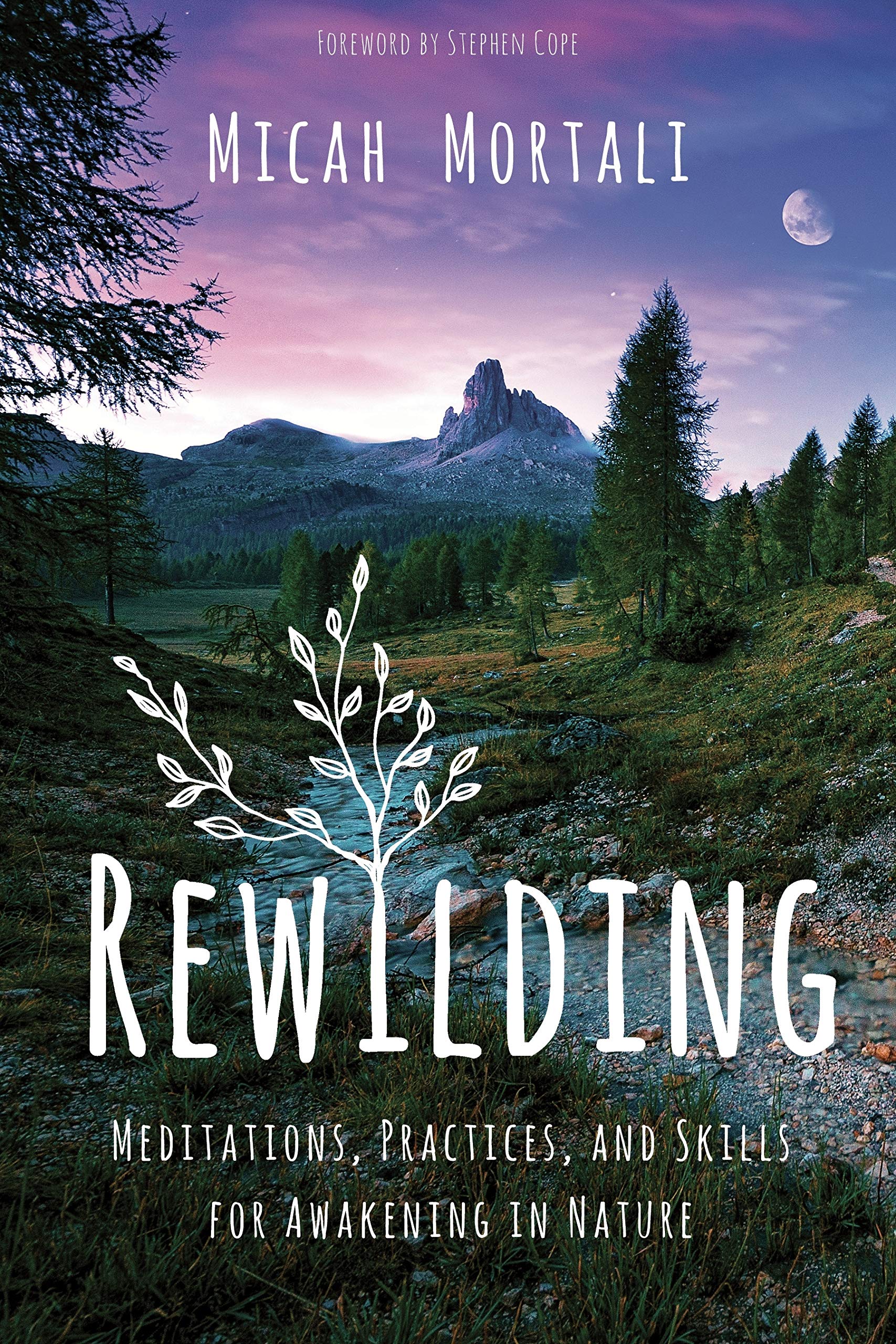 NEW: Rewilding: Meditations, Practices, and Skills for Awakening in Nature, by Micah Mortali (Author), Stephen Cope (Contributor).
 New book (released in December 2019), I'll write more about it soon... It looks like it's going to be great from what I've read so far. From the publisher's info:
Reconnect with your wild essence as you awaken your innate bond with the natural world.
“Rewilding is a return to our essential nature. It is an attempt to reclaim something of what we were before we used words like ‘civilized’ to define ourselves.” ―Micah Mortali
In his long-awaited book Rewilding, Kripalu director Micah Mortali brings together yoga, mindfulness, wilderness training, and ancestral skills to create a unique guide for reigniting your primal energy―your undomesticated true self―and deepening your connection with the living earth.
For hundreds of thousands of years, humans lived intimately with the earth. We were in the wild and of the wild. Today, we live mostly urban lives―and our vital wildness has gone dormant. As a result, we’re more isolated, unhealthy, anxious, and depressed than ever, and our planet has suffered alongside us.
With Rewilding, Mortali invites us to shed the effects of over-civilization and explore an inner wisdom that is primal, ancient, and profound. Whether you live in the middle of a city or alongside the woods, the insights and practices on these pages will bring you home to your wild, wise, and alive self.
Highlights include:
-
Practice-rich content―mindfulness exercises, guided meditations, yoga and pranayama, inward sensing, forest bathing, and much more
-
The “life-force deficit”―explore how our separation from nature affects us physiologically and spiritually
-
Ancestral skills―such as tracking, foraging, building fires, and finding shelter
-
Develop a sense of calm, clarity, connection, and confidence in both your daily life and the great outdoors
-
What you can learn from nature’s teachers―lessons from mountains, rivers, trees, and our animal kin
-
Rewild in the wild―guidelines around safety, preparedness, appropriate gear, and packing lists
-
A mindful rewilding flow―put everything together in an immersive, step-by-step rewilding experience
-
Awaken your authentic spiritual connection with the natural world as you come home to your true self
-
Understand the relationship between our health and the health of our planet―and how we can begin to heal both
Part celebration of the natural world, part spiritual memoir, and part how-to guide, Rewilding is a must-read for anyone who wants to embrace their wild nature and essential place in the living earth.
Purchase from Australia (Fishpond)
Purchase from Amazon.com (USA Site)
Purchase from Amazon.com.au (Australian Site)
|
|
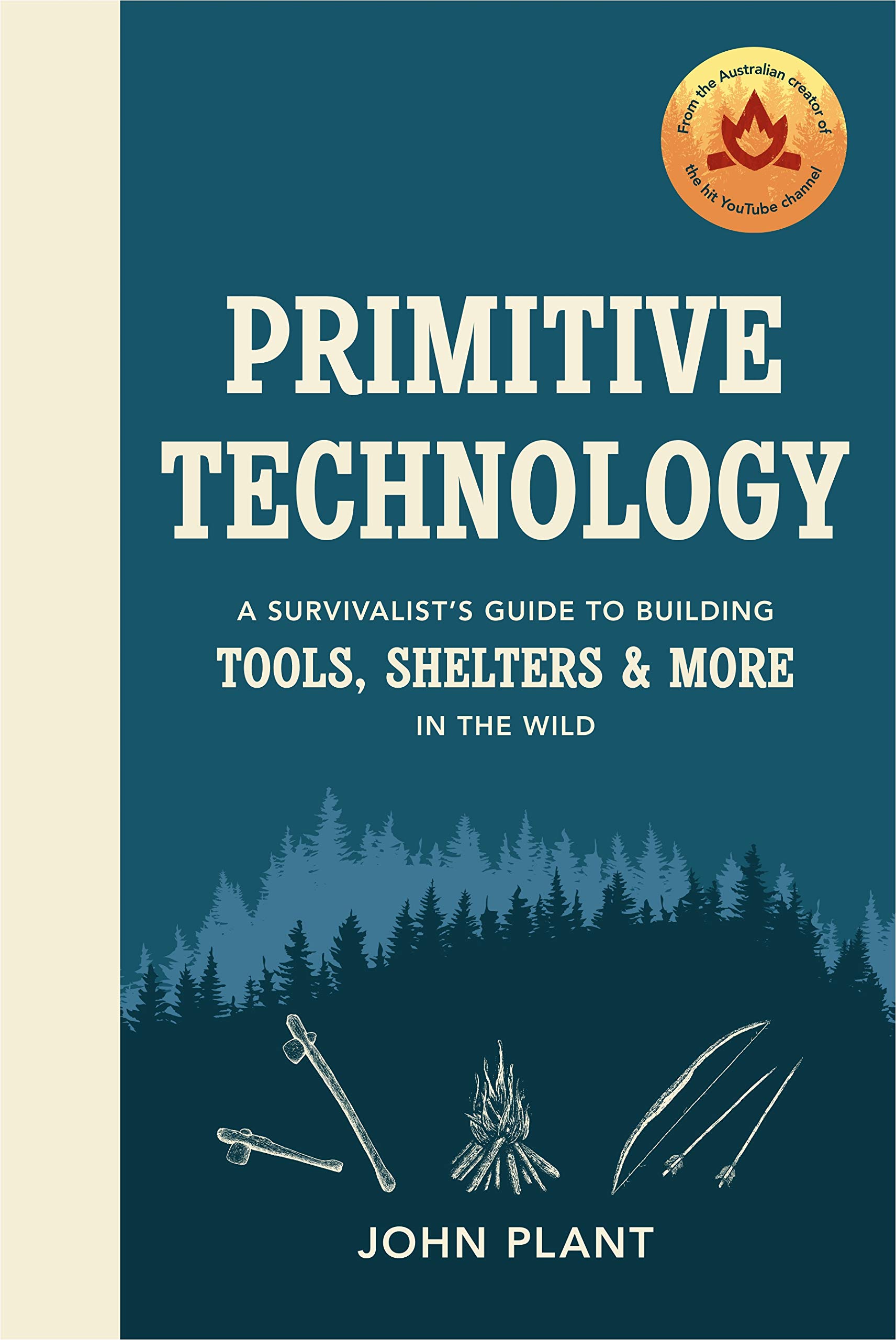 NEW: Primitive Technology: A Survivalist's Guide to Building Tools, Shelters & More in the Wild, by John Plant.
 Primitive Technology is a recent (released October 2019) and very popular book. The author has a YouTube channel which is extremely popular. The book has lots of high-quality colour photos, and information which is at a really good level for beginners. It's currenly (as of July 2020) the most-selling Outdoor Survival Skills book by far.
From the publishers:
From the craftsman behind the popular YouTube channel Primitive Technology comes a practical guide to building huts and tools using only natural materials from the wild.
John Plant, the man behind the channel, Primitive Technology, is a bonafide YouTube star. With almost 10 million subscribers and an average of 5 million views per video, John's channel is beloved by a wide-ranging fan base, from campers and preppers to hipster woodworkers and craftsmen. Now for the first time, fans will get a detailed, behind-the-scenes look into John's process.
Watched by millions online, this is the first time Primitive Technology's ancient methods, rooted in fire, stone, earth, water and plants, have been comprehensively laid out in a book. Through illustrations, photographs and instruction, learn how to create something useful from natural resources and become skilled in the art of fire starting, pottery making, shelter building, spear throwing, basket crafting and much more.
Featuring 50 projects with step-by-step instructions on how to make tools, weapons, shelters, pottery, clothing, and more, Primitive Technology is the ultimate guide to the craft. Each project is accompanied by illustrations as well as mini-sidebars with the history behind each item, plus helpful tips for building, material sourcing, and so forth. Whether you're a wilderness aficionado or just eager to spend more time outdoors, Primitive Technology has something for everyone's inner nature lover.
Purchase from Australia (The Nile)
Purchase from Australia (Fishpond)
Purchase from Amazon.com (USA Site)
Purchase from Amazon.com.au (Australian Site)
|
|
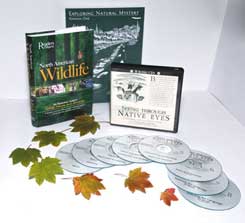 Kamana One by Jon Young, Wilderness Awareness School. The Kamana
program by Wilderness Awareness School (North American) is
an awesome correspondence course teaching wilderness and native
skills and awareness.
Kamana One by Jon Young, Wilderness Awareness School. The Kamana
program by Wilderness Awareness School (North American) is
an awesome correspondence course teaching wilderness and native
skills and awareness.
The focus is more on native awareness and
on learning your local environment (the plants and animals) than on specific survival skills. With this course, it takes a long time
before you knew a lot of actual practical skills — but by the
time you do, your level of knowledge has become very, very deep
and broad. The skills you will learn in Kamana are the foundations for being completely at home in the wilderness in a way that you could never achieve by quickly cramming some practical/technical survival skills. So it is ideal for people who are interested in survival skills as a long-term committment to learning an entire way of life.
It is also ideal for people who are not so interested in wilderness "survival" as such, but want to learn to appreciate and feel more at home in nature. Wilderness Awareness School has a policy of teaching absolutely no (what they call) "survivalist doom and gloom". Everything they offer is required to be 100% positive and inspiring, and they definitely live up to that.
Click here for more information from Wilderness Awareness School (USA) |
|
 Ultimate Guide to Wilderness Living: Surviving with Nothing But Your Bare Hands and What You Find in the Woods, John & Geri McPherson. This is a new version of this important wilderness survival book, under a different title. If you have this book already, don't get the new one since its almost the same content. If you don't have "Naked Into the Wilderness" yet, then this new one is the one to get.
From the publishers, "In-depth instructions and step-by-step photos of real survival skills — exactly what one needs to stay alive in the woods. The book first covers immediate needs like starting a fire, erecting temporary shelter, and finding food. Then it goes beyond other survival books by explaining advanced techniques for long-term living in the wild — using only those things found in nature. The authors show how to make tools by chipping stones, fashion a bow-and-arrow out of tree branches, weave baskets, fire primitive pots, build a semi-permanent shelter, and even tan hides. Finally, the authors explain how to bring all these skills together to live in the wilderness for days, weeks, months, or even years."
Purchase from Australia (Booktopia)
Purchase from Australia (Angus & Robertson)
Purchase from Australia (The Nile) (Probably unavailable)
Click here to purchase from Australia (Fishpond)
Click here to purchase from Amazon.com |
|
 Survival Skills of Native Califofnia, Paul Campbell. If survival books were ranked by how much they weigh, this would easily be either the best (or the worst) book in my collection. Weighing in at 1.1 kilograms, it is a huge book containing lots of information. Despite the title it is much more of a wilderness living book than a survival skills book in the way that most people think of survival skills. It's similar in style to the Wescott "Primitive Technology" books I have described above (apart from this one all being written by the one same person). If you are serious about learning how to live long-term without modern technology, don't even think — just get this one.
Purchase or read reviews on Amazon.com.au
Click here to purchase from Australia (The Nile) (Probably unavailable) |
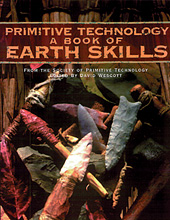 Primitive Technology: A Book of Earth Skills, by David Wescott. Awesome book. From a reader's review, “This is, in my humble opinion, the BEST single source for Primitive Skills out there - PERIOD. If you've ever looked through a scientific journal or periodical, that is the basic layout for this book: a compendium of articles, each one detailing a different tool, task, method, or application of a primitive skill. It isn't a high-cut book you need a PhD to understand. You can take this out in the backyard and follow right along, and succeed!” I would agree completely. Primitive Technology: A Book of Earth Skills, by David Wescott. Awesome book. From a reader's review, “This is, in my humble opinion, the BEST single source for Primitive Skills out there - PERIOD. If you've ever looked through a scientific journal or periodical, that is the basic layout for this book: a compendium of articles, each one detailing a different tool, task, method, or application of a primitive skill. It isn't a high-cut book you need a PhD to understand. You can take this out in the backyard and follow right along, and succeed!” I would agree completely.
Purchase from Amazon Australia
Purchase from Australia (The Nile) (Probably unavailable)
Purchase from Amazon (US) |
 Primitive Technology II: Ancestral Skills - From the Society of Primitive Technology, David Wescott (editor). Primitive Technology II: Ancestral Skills - From the Society of Primitive Technology, David Wescott (editor).
Primitive Technology II: Ancestral Skills provides the guide to rediscovery of the skills and crafts that bind us all into this great human family. Contents: Food Sources, Containers, Projectiles, Buckskin, Transportation Back to Basics. A continuation of the book Primitive Technology, which has been called “the best single source for primitive skills out there — PERIOD.”
Purchase from Amazon Australia
Purchase from Amazon (US) |
|
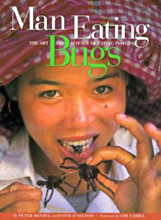 Man Eating Bugs: The Art and Science of Eating Insects, Faith D'Aluisio and Peter Menzel. This is the book to get to shock your friends that are afraid of spiders. The cover has a very memorable photo of a girl eating large black spiders on what looks like a satay stick without the satay sauce. Yum! Would you like flies with that?
Insects and seaweed are possibly the two most under-utilised food sources in the world today, and they will both become important when the output of our fossil-fuel-produced food systems starts to decline. This book has lots of colour photos and small writing, which makes it both interesting to flick through and informative as well. It's written from the perspective of countries where they talk about how people with more body fat are fitter and have more endurance.
Click here to purchase from Amazon Australia
Click here to purchase from Australia (Fishpond)
Click here to purchase from Australia (The Nile) (Probably unavailable) |
|
 Exploring the Outdoors with Indian Secrets, Allan A. Macfarlan. This book should really be called "Exploring the Outdoors with Indian Hunting Secrets", since that is what it is about. It's excellent. It's about bowhunting, deer hunting, how to catch predators like coyotes and foxes, how to get close to big game (like bears and mooses), how to track animals and outguess their moves, how to become invisible (like camofluague and blinds), and how to outwit small game.
Purchase or read reviews on Amazon.com.au
Click here to purchase from Australia (The Nile) (Probably unavailable) |
|
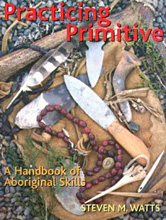 Practicing Primitive: A Handbook of Aboriginal Skills, Steven M. Watts. This book is similar to the "Primitive Techbology" books edited by David Wescott. It contains a bit less information overall, but more drawings, it has larger writing and is easier to read. It's a good one for the collection if you already have the Primitive Technology books and/or Paul Campbell's book (see above on this page) but I would rank these other books ahead of it.
Purchase or read reviews on Amazon.com.au
Click here to purchase from Australia (The Nile) (Probably unavailable) |
|
 Participating in Nature: Wilderness Survival and Primitive Living Skills Thomas J. Elpel. This is one of the best general introductory wilderness living books, however it getting harder to find now. While there is some treatment of emergency-style survival skills, the focus is on long-term living using (mostly) only what is provided by nature. This book is more nicely set out than the Ultimate Guide, and more interesting to read bits from. Participating in Nature: Wilderness Survival and Primitive Living Skills Thomas J. Elpel. This is one of the best general introductory wilderness living books, however it getting harder to find now. While there is some treatment of emergency-style survival skills, the focus is on long-term living using (mostly) only what is provided by nature. This book is more nicely set out than the Ultimate Guide, and more interesting to read bits from.
Purchase from Amazon (US)
Click here to purchase from Australia (The Nile) It's in stock now in June 2020
|
|
 Practical Tracking: A Guide to Following Footprints and Finding Animals, By Louis Liebenberg, Adrian Louw, and Mark Elbroch.
Techniques from international tracking experts applicable to any quarry and terrain. How to follow and find elk, deer, bears, cougars, lions, elephants, leopards, rhinos, cape buffalo, and more. Finding and identifying tracks and sign of an animal's passing is only part of the ultimate goal for serious trackers, hunters, and outdoorspeople. They want to follow the trail to reach the animal in question. This detailed guide teaches them how. Written by a trio of master trackers, it covers what to look for to discern an animal's pathway, what information tracks and sign convey, how to move through the wilderness to get in sight of the quarry, how to avoid dangerous encounters, and more.
Purchase or read reviews on Amazon.com.au
Click here to purchase from Australia (Fishpond)
Click here to purchase from Australia (The Nile) (Probably unavailable)
Click here to purchase from Amazon (US) |
|
 Shelters, Shacks, and Shanties: The Classic Guide to Building Wilderness Shelters, by D. C. Beard. The classic guide from 1914 on building low tech dwellings using only natural locally obtained materials (mainly from trees) and only a hatchet or axe. The book is split into two parts, the first part being shelters you can build with just a hatchet, and the second part those built with a full size axe.
This excellent hands-on guide by one of the founders of the Boy Scouts of America contains a wealth of practical instruction and advice on how to build everything from a bark teepee and a tree-top house to a log cabin and a sod house. No professional architects are needed here; and knowing how to use an axe is more important than possessing carpentry skills. More than 300 of the author's own illustrations and a clear, easy-to-follow text enable campers to create such lodgings as half-cave shelters, beaver mat huts, birch bark shacks, over-water camps, a Navajo hogan, and a pole house.
Additional chapters provide information on how to use an axe, split and notch logs, make a fireplace, and even build appropriate gateways to log houses, game preserves, ranches, and other open areas. An invaluable book for scouts, campers, hikers, and hunters of all ages, this guide and its fascinating collection of outdoor lore will be of keen interest to any modern homesteader.
There are more versions of this book available than just about any other book I've ever seen apart from the Bible and other religions' Holy Books. I have the Dover Publications one which is fine. Some of the more expensive ones presumably have better quality paper.
Click here to purchase from Amazon Australia
Click here to purchase from Australia (Fishpond)
Click here to purchase from Australia (The Nile)
Click here to Purchase from Amazon (US) |
Books for Survival in the Future Hard Times
See also: Instant Bookshelf to Survive The Apocalypse NEW
Which Book(s) to Get?
If you just want to get one or two books and get on with doing what is in them (which is a good idea), read the next few paragraphs. Otherwise just browse through the books this section and see what is interesting to you, and what you think you would be most likely to actually use.
Cody Lundin's book is great for people who aren't into heavily this type of stuff already, and who like a bit of humour thrown in along with all the cold hard facts.
Either of the two books by Arthur T. Bradley are great all round books that anyone can start with.
If you live in an ordinary urban area or a suburb, and you aren't too put off by a "survival" style of book, the Urban Survival Guide would be a good one to start with. If you are the type of person who would prefer a more much gentle, less crisis-oriented book, get The Transition Handbook. If you live (or are planning to live) in a rural area, there are more choices. Rawles book below is good (and very detailed) if you don't mind a pretty hardcore "survivalist" type of book.
Gardening When It Counts would also be another option for best overall book (irrespective of where you live), even though it is only about one topic, and I would recommend it as the second book to get if you get any of the other books and want to get a second book. If you want a practical book that will get you started on one area of activity that is going to become really, really, important, for a lot of people, definitely get this book.
Also check out the Patch From Scratch DVD (although the gardening style used here is a bit different, it is the best DVD I have seen on this topic).
If you would like more information about which book to choose, click on the link to amazon for each book below that looks interesting to you, and read the reviews and (if it has one) check out the "Search inside this book" section at the top left of the Amazon page, under the product image.
The Books
|
 NEW: Absolute Anarchy, by Johnny Jacks.
 This is an excellent book. In fact it's currently the one I'd recommend most of all if you only got one book, in terms of overall coverage of how to survive a collapse of modern civilisation.
From the publisher's information:
Johnny Jacks was born to semiliterate sharecropper parents on January 11, 1944, in Montgomery, Alabama, six months before D-day.
In 1949, several years after WWII and without the means to establish a farm, his family — parents and little sister — moved to Comanche County, Texas where his father's brother helped them to acquire temporary shelter in an old one-room slave house and a 40-acre farm to sharecrop. There he quickly became aware of the demands of living self-reliantly off grid, off city water, without indoor plumbing, and without assistance from a welfare state. In those days, if they didn't grow vegetables, milk the cow, raise and slaughter pigs, raise chickens, harvest wildlife, and preserve their own food, they didn't eat, especially in winter. They eventually moved to a small house that had electricity, but still obtained water from a hand-dug well and made use of a privy with Sears and Roebuck catalogues and corncobs in lieu of toilet paper.
In 1954, following the tragic loss of their farm equipment to a fire, including the tractor, his disheartened father returned them to Alabama where he obtained work in a veneer mill near Selma. They later relocated to Mobile where his father became a common laborer, moving from job to job, anything that provided enough pay to meet their basic survival needs. At the age of twelve, Johnny mowed lawns to help pay the bills and provide for his own needs.
On his seventeenth birthday, he enlisted in the U.S. Air Force, later transferring to the U.S. Army where he became a Special Forces soldier, a Green Beret. He completed training at the U.S. Army Special Warfare Center at Fort Bragg, North Carolina in the spring of 1966 and began a career serving on Special Forces A teams in Europe, Asia, and Central America, including a combat assignment to Special Forces A team 102, Tien Phuoc, Vietnam, 1967-1968. He became proficient in guerrilla warfare strategies and tactics, communications, intelligence gathering, and guerrilla group organization and operations.
After retiring from the Army in 1982, he worked for several government agencies over the next thirty years in significant positions involving national security and emergency preparedness program implementation and policy-making. These roles provided him with knowledge of the national security policy relating to continuity of government and continuity of operations with insight into what will take place with the senior leadership when the Schumer hits the fan and the nation falls into a state of absolute anarchy.
This combination of experience and education in off-grid, self-reliant living, guerrilla warfare, and national security policy imbued him with unique insight into today's individual and group prepper survival needs and requirements and gave him the skills and knowledge needed to defeat organized gangs and other bad guys and assist refugees under a state of absolute anarchy.
Purchase from Amazon.com (USA Site)
Purchase from Amazon.com.au (Australian Site)
|
|
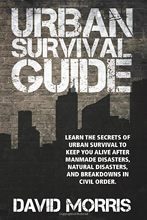 Urban Survival Guide: Learn The Secrets Of Urban Survival To Keep You Alive After Man-Made Disasters, Natural Disasters, and Breakdowns In Civil Order,
David Morris. This is another great book to get if you are likely to still be living in an urban area when the crash happens — which is most modern people. Even if you are not in an urban region, it is still a very useful book, and keep in mind that the author defines urban as any place where your neighbours are closer than 1/4 of a mile (400 metres) away. Which means almost everyone in modern life.
Urban Survival Guide: Learn The Secrets Of Urban Survival To Keep You Alive After Man-Made Disasters, Natural Disasters, and Breakdowns In Civil Order,
David Morris. This is another great book to get if you are likely to still be living in an urban area when the crash happens — which is most modern people. Even if you are not in an urban region, it is still a very useful book, and keep in mind that the author defines urban as any place where your neighbours are closer than 1/4 of a mile (400 metres) away. Which means almost everyone in modern life.
What makes it unique is that it contains a full 12-week urban survival course, complete with excercises and things to do along the way, as you go through the book chapter by chapter.
He uses examples from what happened after hurricane Katrina to demonstrate useful vs not-so-useful things to do. And that many of the things that people will naturally do, without knowing any better, will not be that useful. And what to do instead. Because it is written as a "survival course", going through the book in this way will make sure the information really goes inside your head, and stays there, unlike many books that you might just read and then forget.
Click here to purchase from Amazon Australia
Click here to purchase from Australia (Fishpond)
Purchase from Australia (The Nile) Seems to be unavailable
Click here to view inside or purchase from Amazon (US)
|
|
 When All Hell Breaks Loose: Stuff You Need To Survive When Disaster Strikes, Cody Lundin. I love this book. It's a really fun book — well, as close to fun as you can get when writing about a topic like this. There are silly characters like a talking cow, and things like that, which can really help to ease some of the "This is it: we're all going to die" feeling of doom that this subject can sometimes bring up.
There are a few bad reviews of it on Amazon by people who don't like this kind of approach (if you are one of these people, you would probably prefer a book like Rawles' one, which is in some ways more advanced than this one).
This would be a great book (perhaps the best one I've seen) to buy for someone "normal" (i.e. who isn't heavily into this "survivalist" stuff already).
Purchase from Amazon Australia
Purchase from Australia (The Nile) (free shipping)
Click here to Purchase from Amazon (US) |
|
 Gardening When It Counts: Growing Food in Hard Times, Steve Solomon. This book covers exactly the things that people will want to know about gardening in a few years time when the food in the shops starts to run short. This is one of the three or four books on this website where I say "don't even think, just get this one".
When I first started growing vegetables again (again meaning as an adult rather than helping my Dad or my Grandfather), the thing that really concerned me — and depressed me — was how much water was needed to keep them alive in the summer drought. The methods taught in this book are exactly the thing that I have been looking for all this time.
The back cover comments say "Applicable to most areas in the English-speaking world except the tropics or hot deserts [so take that into account if you live in either of those climates], this book shows that any family with access to about 400 square metres of garden land can halve their food costs in most climates using just the odd bucketful of household waste water, a few hand tools, and a few hundred dollars per year spent on supplies and seeds — working just an average of two hours a day during the peak growing season."
More from the back cover: "The decline of cheap oil and the threat of harder times to come is prompting people to grow more food themselves. But currently popular intensive vegetable gardening methods depend on cheap oil, requiring high inputs of water, fertility and organic matter. Prior to the 1970s, home food growing used more land because wider plant spacing reduces the need for irrigation and requires lower levels of soil fertility to be productive — and well-spaced plants can be weeded rapidly and conveniently with hand tools while standing upright. But these efficient systems have been largely forgotten."
"It covers a host of material, including:
- Vegetables ranked by how difficult they are to grow
- Root systems as the key to gardening mastery
- Seeds, spacing and irrigation
- Home made organic fertiliser that really works
- How to choose, use and sharpen hand tools
- Compost making, root-cellaring and irrigation
- Chemical-free handling of insects and diseases"
"Designed for readers with no experience, yet and eye-opener for even the seasoned gardener, Gardening When It Counts returns the backyard food garden to center stage for uncertain times ahead."
Purchase from Amazon Australia
Purchase from Australia (Fishpond)
Purchase from Australia (The Nile)
Purchase from Amazon (US) |
|
 The LDS Preparedness Manual.
This is a free downloadable PDF book. Highly recommended. Yes "LDS" refers to the Mormon Church (i.e. the Church of Jesus Christ of Latter-day Saints), but there is a massive amount of content in here that will be useful for everyone. There is also a hard copy version available from Amazon (US), which at the time I'm writing this has 42 reviews, 41 of them 5/5 stars, and one 4/5.
Free download link here. (Note that it asks for your email address, but any email address will do, e.g. john@msn.com.) If you click on the link you can view the table of contents on the HTML page before you download it.
Purchase from Amazon (US) |
|
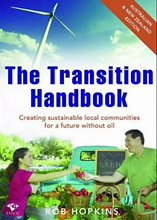 The Transition Handbook, Rob Hopkins.
This is the book to get first if you're the type of person who would be more likely to read a more gentle, less "survivalist" style of book. It doesn't contain as many practical "do this then do that" steps of how to prepare yourself individially than some of the other books listed here, but it is a lot more community oriented (and many people would say, more positive). Its great strength is the way it shows how to get together with groups of people in your local community and prepare together.
Spiel: "We live in an oil-dependent world. Most of us avoid thinking about what happens when oil runs out (or becomes prohibitively expensive), but The Transition Handbook shows how the inevitable and profound changes ahead can have a positive outcome. These changes can lead to the rebirth of local communities that will grow more of their own food, generate their own power, and build their own houses using local materials. They can also encourage the development of local currencies to keep money in the local area. There are now over 30 transition townsa in the UK, Australia and New Zealand, with more joining as the idea takes off. They provide valuable experience and lessons-learned for those of us on this side of the Atlantic. With little proactive thinking at the governmental level, communities are taking matters into their own hands and acting locally. If your town is not a transition town, this upbeat guide offers you the tools for starting the process."
It also has a huge amount of advice on how to deal with the coming changes, and how to help others deal with them, including advice on how to cope with your own "end of suburbia moment" — the point at which you first really "get" peak oil and its implications.
Purchase or read reviews on Amazon.com.au
To read reviews or look inside it, click on the Amazon link below.
Click here to purchase from Australia (Fishpond)
Click here to purchase the 2009 Australia and NZ Edition.from Australia (The Nile) Probably unavailable
Click here to purchase the 2008 International Edition.from Amazon (US) |
|
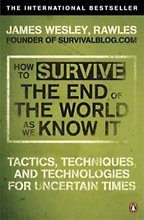 How to Survive The End of The World as We Know It, James Wesley Rawles. This is one of the best all-round books I have seen for long-term (i.e. post-global-economic-collapse) survival.
There are a few criticisms, the main one being that a lot of it is about stocking up on various different types of equipment, and he takes this a bit too far for most people. It is actually really easy to fall into the trap of thinking that you need to purchase for yourself enough equipment to (as closely as possible) replicate the material and technological standards of living of the unsustainable and grossly over-consuming modern world. I think that Mr Rawles (at least somewhat) falls into that trap.
Having got that out of the way, this book covers so much that people will need to know about in the future. If you start on this right now, today, then you will have as long as possible to change your attitudes and your life before the proverbial s**t hits the fan (and you are forced to change them very rapidly).
He doesnt cover an "escape into the wilderness" type of approach at all, so that is also something to be aware of. If you are looking for that, see "Bug Out" below on this page.. But then, this book is so good (in terms of how much useful information it contains) that even if hiding out in the woods is more to your liking, you could still learn a lot from it. His main approach is to have a "retreat" location, which is in a rural area, where (ideally) you move to before trouble begins, or alternatively, have prepared so that you can move there quickly when you need to.
Purchase or read reviews on Amazon.com.au
Click here to purchase from Australia (The Nile) (Probably unavailable) |
|
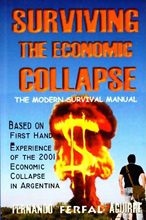 The Modern Survival Manual: Surviving the Economic Collapse,
Fernando "Ferfal" Aguirre. Ferfal's book is based on his own experiences in Argentina before and after their economic collapse in 2001. This has its advantages and disadvantages. The main advantage being that he knows from experience what he is talking about. This is unlike most of the "how to survive the end of the world"-type of books, which are written by people who have not survived the end of the world before. The disadvantage, though is that it does give his approach a lot of bias towards the circumstances that happened in Argentina where he lived. That is, it might not work so well in different circumstances. Having said that, there is a huge amount of information that would be useful in a wide range of circumstances.
The Modern Survival Manual: Surviving the Economic Collapse,
Fernando "Ferfal" Aguirre. Ferfal's book is based on his own experiences in Argentina before and after their economic collapse in 2001. This has its advantages and disadvantages. The main advantage being that he knows from experience what he is talking about. This is unlike most of the "how to survive the end of the world"-type of books, which are written by people who have not survived the end of the world before. The disadvantage, though is that it does give his approach a lot of bias towards the circumstances that happened in Argentina where he lived. That is, it might not work so well in different circumstances. Having said that, there is a huge amount of information that would be useful in a wide range of circumstances.
One thing that he says, which many survivalists would disagree with, is that you will be possibly much better off in a city than in a rural area. Although he does make a concession that a small country town would possibly be the best option, his experience and bias is clearly towards living in a city or urban location. This means that if you cannot imagine yourself living in a rural location, I would recommend this book as one of the best that I have seen on this topic. I think that the reason he is so in favour of living in an urban location is that things did not really get that bad in Argentina, compared to some of the possible "Armageddon"-type scenarios that might happen in the future when there is no more cheap oil or economic growth.
Overall this is an excellent book and one that I would highly recommend.
Purchase or read reviews on Amazon.com.au
Click here to purchase from Amazon (May not ship this to AU from the US site) |
|
 Nuclear War Survival Skills, Updated and Expanded Edition,
Cresson H. Kearny. This is the "bible" of how to survive a nuclear war. Reading just a small amount of this book will have you convinced that the possibility of surviving a nuclear war is in fact much, much greater than most people believe — provided that you follow a few simple but necessary steps. It explains the basic things you need to to do to protect yourself, especially in the critical first few days after the explosion. The techniques are meant to be used by ordinary people, with access to simple household items, not requiring huge budgets and high-tech shelters.
Nuclear War Survival Skills, Updated and Expanded Edition,
Cresson H. Kearny. This is the "bible" of how to survive a nuclear war. Reading just a small amount of this book will have you convinced that the possibility of surviving a nuclear war is in fact much, much greater than most people believe — provided that you follow a few simple but necessary steps. It explains the basic things you need to to do to protect yourself, especially in the critical first few days after the explosion. The techniques are meant to be used by ordinary people, with access to simple household items, not requiring huge budgets and high-tech shelters.
Nuclear War Survival Skills can be read for free online on the author's website. The online version is the 1987 edition, which is the same as the current 2001 edition except it does not have the addendum on hormesis. Hormesis is the idea that extremely low doses of radiation are not only unharmful, but stimulate the body's defence mechanisms in a way that improves their tolerance to higher doses of radiation that may follow. The addendum is only one page long but it is a good read and adds a positive tone to the end of the book.
It can be downloaded for free from survival.org.au here.
This book is so good that at the time I originally wrote this, out of 19 reviews, every single reviewer on Amazon.com has rated it 5 out of 5 stars. This is almost never seen. Since then the very few poor reviews are mainly complaining that the book is too old. Hydrogen bombs have been around since the 1950s and things have not really changed that much in terms of how to protect against fallout, blast, etc.
There's also a DVD series by Cresson Kearny, the author of this book, available from here. I have seen the DVDs and they are also extremely good, it's $149 USD for the 8-DVD set. Two or three (possibly more which I haven't found) of the clips from them are available on YouTube (see here).
 NEW Updated 2022 version here from Amazon Australia. "Updated and Expanded 2022 Edition Regarding Ukraine Russia and the World: The Best Book on Any Nuclear Incident Ever." NOTE that you need to buy the paperback, not the hardcover version to get the 2022 updated edition. NEW Updated 2022 version here from Amazon Australia. "Updated and Expanded 2022 Edition Regarding Ukraine Russia and the World: The Best Book on Any Nuclear Incident Ever." NOTE that you need to buy the paperback, not the hardcover version to get the 2022 updated edition.
Click here to Purchase from Amazon (US) Green cover version.
Below is the red cover version, recent 2016 printing.
Purchase red cover version from Australia (The Nile) (Available as of July 2024)
Purchase red cover version from Amazon (US)
Below is the slightly older 2012 "Red Dog" edition which confusingly has a black cover. This version has a smaller page size and more pages than the original.
Purchase black cover version from Australia (The Nile) (Probably unavailable)
Purchase black cover version from Amazon (US) |
|
 U.S. Armed Forces Nuclear, Biological And Chemical Survival Manual: Everything You Need to Know to Protect Yourself & Your Family From the Growing Terrorist Threat, by Captain Dick Couch and Captain George Galdorisi. 242 pages. The author Captain Dick Couch is a retired Navy SEAL, combat veteran and CIA case officer. The book covers protection from nuclear, biological, and chemical attacks. The chapter on nuclear agents is 22 pages long, plus another 19 pages of appendix about the effects of nuclear agents (like radiation sickness). The rest of the book, covering biological and chemical threats is also very good. U.S. Armed Forces Nuclear, Biological And Chemical Survival Manual: Everything You Need to Know to Protect Yourself & Your Family From the Growing Terrorist Threat, by Captain Dick Couch and Captain George Galdorisi. 242 pages. The author Captain Dick Couch is a retired Navy SEAL, combat veteran and CIA case officer. The book covers protection from nuclear, biological, and chemical attacks. The chapter on nuclear agents is 22 pages long, plus another 19 pages of appendix about the effects of nuclear agents (like radiation sickness). The rest of the book, covering biological and chemical threats is also very good.
There's a chapter covering a comprehensive family action plan. A quote from the retired Secretary of Defence Robert McNamara, referring to the threat of nuclear weapons, says "In some wartime situations a reasonable Civil Defence program could do more to save lives than many active defence measures". The author then says "In fact, I would submit that the threat of attack is higher today than during the Cold War with the prospect of Soviet atomic attack. A Family Emergency Action Plan will do more to save lives than almost any activity carried out by the government". Which is one of the rare cases where the bold font I've used in the quote was not added by myself, but part of the original text.
From the publisher, "It contains the best practices of the United States' military, completely edited and adapted for civilian use. For example, readers will learn how to: Gain knowledge of an impending chemical attack using a simple warning system; Protect against biological threats such as anthrax with a series of inoculations; Guard against fallout from a terrorist nuke; Achieve basic protection during chemical or biological attacks with a simple mask; and Administer first aid after nuclear, chemical or biological attacks with a simple first aid kit. It's all here. This handbook is the single most effective tool for civilians to protect themselves and their loved ones against the threat looming over our homeland."
Purchase or read reviews on Amazon.com.au
Purchase from Amazon (US) |
|
 Disaster Preparedness for EMP Attacks and Solar Storms (Expanded Edition), by Arthur T. Bradley. This book will help you to prepare for two end-of-the-world-as-we-know-it (TEOTWAWKI) events: the EMP attack and the solar storm. Each threat is carefully studied with analyses of its likelihood and potential impacts on our nation’s critical infrastructures. Practical preparations are outlined, including steps to meet the fourteen basic needs in the absence of modern utilities, and the use of Faraday cages and uninterruptible power supplies to protect personal electronics. Several techniques for constructing ad-hoc Faraday cages are presented. Disaster Preparedness for EMP Attacks and Solar Storms (Expanded Edition), by Arthur T. Bradley. This book will help you to prepare for two end-of-the-world-as-we-know-it (TEOTWAWKI) events: the EMP attack and the solar storm. Each threat is carefully studied with analyses of its likelihood and potential impacts on our nation’s critical infrastructures. Practical preparations are outlined, including steps to meet the fourteen basic needs in the absence of modern utilities, and the use of Faraday cages and uninterruptible power supplies to protect personal electronics. Several techniques for constructing ad-hoc Faraday cages are presented.
The shielding effectiveness of homemade Faraday cages is measured and compared, including metal garbage cans, foil-wrapped boxes, fire safes, anti-static bags, ammo cans, microwave ovens, and full-sized protective rooms. These are really good, I think just the pages of tables showing test results of different methods of EMP shielding alone is worth the price of the book.
Purchase from Amazon Australia
Purchase from Amazon (US)
|
|
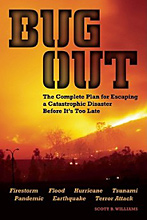 Bug Out: The Complete Plan for Escaping a Catastrophic Disaster Before It’s Too Late, Scott B. Williams. If you are looking to escape into the wilderness when the global economy is no more, this is your book. The only downside (for people outside the USA) is that 200 of the 300 pages are about locations inside the USA that would be good to live in if you want to be as far away from people as possible. Still, the 100 other pages are easily worth the price of the book in my opinion and you will learn at least a few things that you might not have thought of before.
If you are seriously considering this type of approach, one really nice thing is that you don't need to buy that much gear (since basically everything you have you are going to be carrying with you, apart from that which you might stash away secretly somewhere).
One thing that surprised me when I started reading it, is how, even in the USA, Mr Williams makes it seem really clear that there would be plenty of remote places to live in, miles away from anyone else that might give you trouble. With that being the case, it seems that it would be 1000 times easier to try to do the same thing here in Australia, considering how low our population is compared to the USA, and how much of our population is concentrated in cities. It is really easy to forget just how much wide open space there really is out there.
Purchase or read reviews on Amazon.com.au
Click here to purchase from Australia (Probably unavailable) |
|
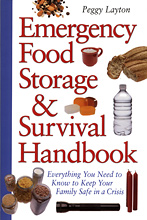 Emergency Food Storage & Survival Handbook: Everything You Need to Know to Keep Your Family Safe in a Crisis, Peggy Layton. Peggy's book is mostly about food storage. It is a really friendly book, the type you could give to someone who is not really into "that survivalist stuff", without scaring them almost to death (or scaring them too much to want to read the book). There are recipies and a lot of pages with tables that have blank boxes that you can use to write in the items that you need and the items that you have in storage and things like that. There are sections on preserving foods, how to garden, and other things that you will need in the future. Unlike most of the other books, it doesn't really say anything about self-defence. Also it's not as in-depth as some of the other books I have reviwed, but it is very easy to read and it does not give you the feeling that you need hundreds of years of spare time to actually do the things that she recommends. This also means it is an excellent book to get if you are new to this type of stuff.
Purchase or read reviews on Amazon.com.au
Click here to purchase from Australia (The Nile) (Probably unavailable) |
|
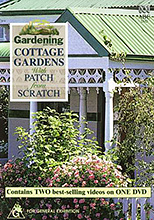 Patch From Scratch & Cottage Gardens, by Peter Cundall and Gardening Australia (DVD). This is a combination of two videos that used to be sold separately on VHS. The "Patch from Scratch" video is really, really good if you want to learn from scratch about how to grow vegetables organically. In Patch from Scratch, Peter Cundall shows you step-by-step how to start a vegetable garden, beginning with an ordinary suburban lawn. He goes through each season (some of then broken into early and late) for 18 months, describing everything in amazing detail. There is so much information in this video you could watch it 100 times and still learn more. The only real criticism (if you can even call it that) I can think of is that it is so densely packed with information, your brain gets saturated after 10 or 15 minutes. So don't expect to take it all in in one sitting. I would recommend watching it through all the way just for an introduction, and then watch just the section for each month that you are up to, and do what he explains in that month/season.
Purchase from Australia (Fishpond) (Probably unavailable, working sometimes) |
|
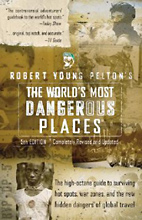 The World’s Most Dangerous Places, Robert Young Pelton. This is the book to get if you are at all frightened (you don't have to admit it to anyone) about the idea of living in a war zone, a collapsed economy, or somewhere with significant civil unrest. Since all of these things are likely to happen to Western countries at some point in the future, it would be good reading for anyone really.
It's a thick book, over 1000 pages, not the type of book you would expect to read from front to back. Its kind of like a "Lonely Planet" style of guide — to the places that no sane person would ever want to visit. A lot of it is humorous, the humour begins in the first paragraph inside the title page where Mr Young assures that anyone "stupid enough to use this as a travel guide" is on their own, and that any tiny country or dictator who would like a more favourable description than he gives them is welcome to send any corrections to him along with a cheque for $500,000.
The real benefit of this book is that reading it will gradually bring your mind more and more around to the idea that all this violence and death is much less of an issue than how you used to feel. This especially applies to anyone (such as myself) who has lived all their life in safe western countries.
It will also get you used to the idea that economic collapse and the things that go along with it are already happening to much of the world. In a strange way, this can actually be really reassuring — when you spend a lot of time focused on the upcoming "global economic collapse", it can seem hard to imagine in a daunting, freaky kind of way. In "DP" (as Robert calls his book), you can get a good feeling for how these things have already happened to much of the world, and the world still turns, and you can even have a bit of a laugh about it, and basically be entertained while you are doing it. The style reminds me of "The Hitch-Hiker's Guide to the Galaxy" from the 1980s — not the books by Douglas Adams but the actual guide itself that was described in those books.
Click here to purchase from Amazon Australia
Click here to purchase from Australia (The Nile) (Probably unavailable) |
|
 Where There is No Doctor, David Werner. This is the standard medical book for places without modern medical care. It's not a "wilderness medicine" style of book designed to keep you alive until you can be helicopter-lifted to a modern first-world hospital. It's the book to get if you have ever wondered how people would get by in the absence of modern Western high-tech medical care.
Having been written for people in third-world countries who might not have much english or a uni degree in medical science, it's also very easy to understand.
From the sales pitch — "With 3 million copies in print in over 50 languages, Where There Is No Doctor is the most widely used health care manual in use in developing countries today. Using simple language and hundreds of drawings, the book provides information about recognising, treating and preventing common illnesses and injuries. But it is far more than simple first aid information. It covers a wide range of subjects that affect the health of the villager - from diarrhoea to tuberculosis, from helpful and harmful home remedies to the cautious use of certain modern medicines. Special importance is placed on cleanliness, a healthy diet, vaccination, childbirth and family planning."
Purchase or read reviews on Amazon.com.au
Click here to purchase from Australia (The Nile) (Probably unavailable) |
|
 Where There Is No Dentist, by Murray Dickson.
 This is my favourite of the Christian martyr stories I've read. I really think it's one of those classic books that everyone should read. The product description says "This is the intensely dramatic story of how God took a young, half-starved boy from a poor village in Henan Province and used him mightily to preach the gospel, despite horrific opposition. Brother Yun is one of China's house church leaders, a man who despite his relative youth has suffered prolonged torture and imprisonment for his faith. Instead of focusing on the many miracles or experiences of suffering, however, Yun prefers to emphasise the character and beauty of Jesus. This astonishing book will form a watershed in your spiritual life." It's also available as set of audio CDs, and a comic book style version.
Purchase from Amazon.com (USA Site)
Purchase from Amazon.com.au (Australian Site)
|
|
 The Survival Medicine Handbook: A Guide for When Help is Not on the Way, by Joseph and Amy Alton.
 The Survival Medicine Handbook is a guide for those who want to be medically prepared for any disaster where help is NOT on the way. The Survival Medicine Handbook is not your standard first aid book. It assumes that no hospital or doctor is available in the aftermath of a catastrophic event. This book will give you the tools to handle injuries and illness for when YOU might be the end of the line with regards to your family's medical well-being. In circumstances where medical personnel are overwhelmed and access to modern technology is limited or non-existent, The Survival Medicine Handbook is the essential reference book for every library. Written in plain English, you'll find step-by-step instructions on how to identify and treat over 100 different medical issues.
Purchase from Amazon.com (USA Site)
Purchase from Amazon.com.au (Australian Site)
|
|
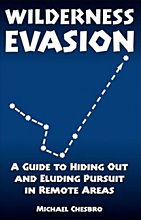 Wilderness Evasion: A Guide to Hiding Out and Eluding Pursuit in Remote Areas, Michael Chesbro. This is the only book I have seen on this topic. Most of the survival books have a chapter on how to get other people to find you, this is the book for if you think you might ever not want to be found.
The advertising for this book goes "Do you need to get away from the pressures of the world and the gaze of Big Brother for a while? Do you plan to live or work in a remote area where you need to be able to take care of yourself? Do you want to develop the skills to remain undiscovered in the back country - even if others are searching for you? If so, Wilderness Evasion is for you. You don't have to be on the run to benefit from this unique survival book: it includes skills you can use every day in your real life. Whether you're heading into the woods for evasion purposes or just a little relaxation, you should know what this manual can teach you about survival medicine, emergency caching, communications, food and water procurement and storage, counter anti-tracking, and the psychological aspects of being alone in the back country, among other things. The ability to remain alive, self-reliant and in control of your environment - even in the remotest of areas - is one that few people possess these days. Learning the skills taught in this book can keep you alive for as long as you need to be in the wilderness. For academic study only." Note the disclaimer at the end that it is for academic study only.
Purchase or read reviews on Amazon.com.au
Click here to purchase from Australia (The Nile) (Probably unavailable)
|
|
 Secret Garden of Survival: How to grow a camouflaged food- forest, by Rick Austin. 2012. This is the first book of a three book series. The few negative reviews concentrate on the books' price per page being a bit high — however this is often the case for niche market, independently published books. Secret Garden of Survival: How to grow a camouflaged food- forest, by Rick Austin. 2012. This is the first book of a three book series. The few negative reviews concentrate on the books' price per page being a bit high — however this is often the case for niche market, independently published books.
Imagine a food garden that you only have to plant once in your life-time, that takes up very little space, that will provide food for you and your family for the next 30 years; that can grow five times more food per square foot than traditional or commercial gardening; and where you never have to weed, never have to use fertilizers and never have to use pesticide-- ever. All diguised as overgrown underbrush, so nobody knows you have food growing there! This book will show you how to do it in one growing season!
Purchase or read reviews on Amazon.com.au
Click here to purchase from Amazon.com (May not ship to AU)
Click here to purchase from Amazon.co.uk (May not ship to AU) |
|
 Secret Greenhouse of Survival: How to Build the Ultimate Homestead & Prepper Greenhouse (Secret Garden of Survival series volume 2), by Rick Austin. 2013. This is the second book of a three book series.
This is the ultimate sustainable homestead and prepper greenhouse, but purposely doesn’t look like it. Imagine a greenhouse that heats your home in the winter; and heats your water; that grows five times more food per sq. ft. than a hoop house; that provides food for you and your family all year long; where your food grows in 3 dimensions; where you never have to use fertilizer; where you never have to use pesticide, and where you can grow exotic foods (i.e. citrus or coffee trees in New England); that allows you to start seedlings in the spring; that hides your solar electric system; and that can house your small animals or incubate chickens and ducks. All disguised to look like a porch on your home, so that desperate and hungry passersby would have no idea that you have food growing there. This greenhouse does all that.
Purchase or read reviews on Amazon.com.au
Click here to purchase from Amazon.com (May not ship to AU)
Click here to purchase from Amazon.co.uk (May not ship to AU) |
|
 Secret Livestock of Survival: How to Raise The 10 Best Choices For Retreat And Homestead Livestock (Secret Garden of Survival series volume 3), by Rick Austin. August 2016. By the author, "When most people think of raising homestead livestock, they invariably think that they must have chickens and a cow. But truth be told, when it comes to raising livestock, there are a lot of reasons to avoid raising chickens altogether, and almost every reason not to own a cow. Secret Livestock of Survival: How to Raise The 10 Best Choices For Retreat And Homestead Livestock (Secret Garden of Survival series volume 3), by Rick Austin. August 2016. By the author, "When most people think of raising homestead livestock, they invariably think that they must have chickens and a cow. But truth be told, when it comes to raising livestock, there are a lot of reasons to avoid raising chickens altogether, and almost every reason not to own a cow.
Just like in my previous two books in this series, the Secret Livestock of Survival- How to Raise the Very Best Choices for Retreat and Homestead Livestock, will show you how to grow your own sources of food (in this case- protein), with a much better return on your investment of time, money, feed, housing and real estate, than with traditional homestead thinking. And these livestock animals are discrete, so most people won’t even know you are raising them.
I wrote this book, as the book that I wish I could have read, before I made my venture into raising livestock. Because if this book had been available then, I could have done it right the first time, and saved myself a lot of time, heartache and money!
Now you can learn what I have learned, without having to learn it the hard way.
If you are serious about raising livestock, whether you are an existing homesteader, or just getting started, this book will save you many hundreds of times what it costs you to buy right now. (And the information contained in this book, can replace the need for you to buy about 10 other livestock books.)
You can now live off the grid. Not just the electrical grid, but off the industrial food grid. And the less you are reliant on the industrial food chain, the wealthier and more secure you will be."
Purchase or read reviews on Amazon.com.au
Click here to purchase from Amazon.com (May not ship to AU)
Click here to purchase from Amazon.co.uk (May not ship to AU) |
Other Survival Books
|
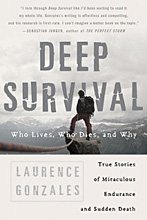 Deep Survival: Who Lives, Who Dies, and Why Laurence Gonzales. This is an awesome book which I definitely recommend to anyone interested in this kind of stuff. It is organised as a "storybook", that is, the kind of book you can just read from front to back, rather than a reference book (many of the other books on this page are reference books). You will learn a huge amount about real-life survival situations from reading these true stories.
The spiel for "Deep Survival" goes like this:
Fascinating for any reader, and absolutely essential for anyone who takes a hike in the woods, this book will change the way readers understand themselves and the great outdoors.
After her plane crashes, a seventeen-year-old girl spends eleven days walking through the Peruvian jungle. Against all odds, with no food, shelter, or equipment, she gets out. A better-equipped group of adult survivors of the same crash sits down and dies. What makes the difference? Examining such stories of miraculous endurance and tragic death-how people get into trouble and how they get out again (or not) — Deep Survival takes us from the tops of snowy mountains and the depths of oceans to the workings of the brain that control our behavior. Through close analysis of case studies, Laurence Gonzales describes the "stages of survival" and reveals the essence of a survivor-truths that apply not only to surviving in the wild but also to surviving life-threatening illness, relationships, the death of a loved one, running a business during uncertain times, even war.
Laurence Gonzales is a contributing editor for National Geographic Adventure magazine. The winner of numerous awards, he can be found at his website www.deepsurvival.com.
Click here to purchase from Amazon Australia
Click here to purchase from Australia (The Nile, Soft Cover) (Probably unavailable)
Click here to purchase from Australia (The Nile, Hard Cover) (Probably unavailable) |
See Also
My Top Two Survival Books
Survival DVDs
Survival Courses Near Sydney and the Blue Mountains
Australian Field Guides and Nature Books
Instant Bookshelf to Survive The Apocalypse NEW
Permaculture, Self Sufficiency And Sustainable Living Books
Books by Tom Brown, Jr.
Dystopian Fiction / Novels
Books About Near-Death Experiences
Waterproof Bible
Return to Resources
Return to Site Map
alive already amazon amount anyone army art au australia australian author basic become before book books brown building bushcraft case chapter chemical city contains cover covers everything experience family field fire fishpond food free garden gardening give great grow growing guide handbook home house huge idea information inside interesting john keep learn life live livestock living makes manual medical modern natural nature never nile nuclear own page pages people person plants practical primitive read recommend reviews ross seen self series shelters ship simple site skills step style survival survive takes technology term times tom tools type unavailable urban usa useful version war water wild wilderness without woods world written years
Content is copyright © Survival.org.au 2005-2026 All Rights Reserved. Terms of Use. Definitely read the disclaimer before trying anything from this website, especially including the practices and skills. This website uses affiliate links – this doesn't cost you any more, but I get a commission on purchases made through the website. As an Amazon Associate I earn similarly from qualifying purchases.
|